
Why Auto Accident Injuries Require a Different Approach
The most common complaint pattern after an auto accident — neck stiffness, headaches, low back tightness, and shoulder pain — looks superficially similar to complaints from overuse, poor posture, or stress. The underlying mechanism is completely different, and the evaluation has to reflect that.
A collision transmits force into the spine faster than the muscles can respond. The result is a combination of ligament strain, facet joint irritation, disc involvement, and deep muscle injury that doesn't appear on standard X-ray and may not fully develop symptomatically for 24 to 72 hours after impact. The adrenaline response that follows a crash suppresses pain signaling in the immediate aftermath — which is why "I felt fine right after" doesn't tell you much about what actually happened to your spine.
Evaluating an auto accident patient means assessing the mechanism of injury, the specific structures involved, and the functional limitations that result — not just asking where it hurts and adjusting accordingly. A provider who doesn't distinguish between a collision injury and a general musculoskeletal complaint is likely to miss the clinical picture that matters most.
What a Thorough Auto Accident Evaluation Should Cover
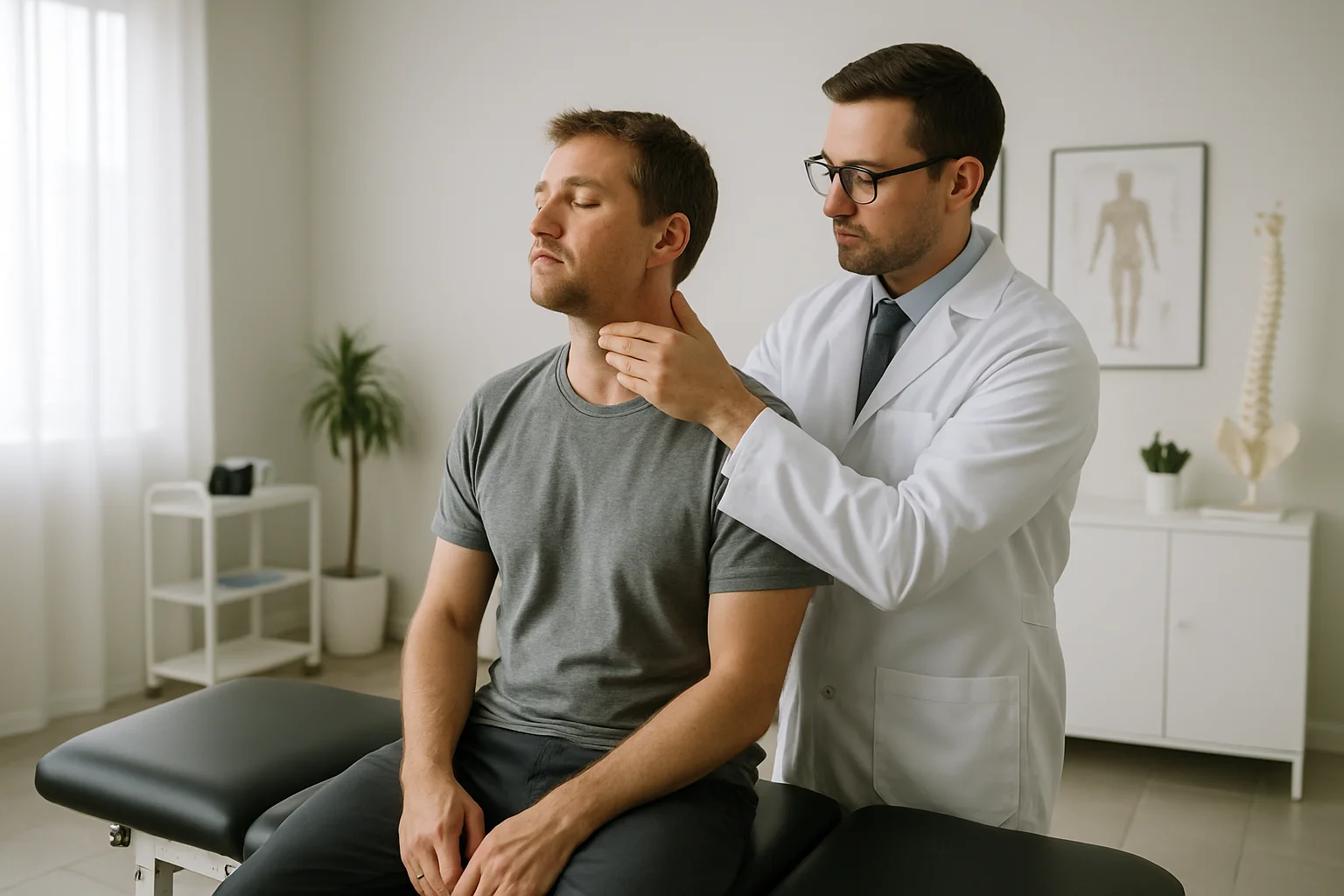
When you see a chiropractor for auto accident injuries, the initial evaluation should be more comprehensive than a standard new-patient visit. Here's what that looks like in practice:
Mechanism of Injury History
The direction and speed of impact, your position in the vehicle at the time of the collision, whether you were aware the impact was coming, and what happened to your head and neck during the crash all predict which structures are most likely injured and how severely. A provider who doesn't ask these questions is skipping clinical information that directly shapes the assessment.
Orthopedic and Neurological Testing
Specific tests assess the stability of ligaments, the integrity of disc function, nerve root involvement, and the mechanical behavior of the joints most commonly affected by collision. These findings are documented in objective terms — not just "patient reports pain" — and they establish the baseline that subsequent visits are measured against.
Range of Motion Assessment
Restricted cervical rotation, lateral bending, and flexion/extension following an accident are measurable and repeatable findings. Documenting them at the first visit allows you to track real progress — or to identify when a particular approach isn't working and adjust the plan accordingly. It also matters clinically: a range of motion that isn't improving after several weeks of care is a signal worth investigating, not ignoring.
Imaging Review or Referral
X-rays don't show soft tissue, but they rule out fracture and reveal alignment issues that matter for treatment planning. If there are signs of instability, significant disc involvement, or neurological compromise, MRI referral may be warranted. A provider who never refers for imaging or who refers every patient for imaging without clinical justification is operating at both extremes of a spectrum that should be guided by findings, not habit.
What the Treatment Plan Should Look Like
One of the clearest signals about whether a practice is actually oriented toward auto accident care is what happens after the evaluation. A well-structured auto injury treatment plan has defined goals, measurable milestones, and a realistic endpoint. It isn't indefinite.
For a straightforward whiplash presentation with no neurological involvement, active care typically runs four to eight weeks. The approach combines spinal adjustment to restore joint mechanics, soft tissue work to address the guarding and restricted mobility that develops in the injured muscles and ligaments, and progressive exercise to rebuild stability. Frequency tapers as function returns — it isn't maintained at the same level until a case settles.
What should raise concern is care that continues without reassessment, that never changes in frequency regardless of progress, or that has no defined endpoint. Those patterns don't serve patients clinically, and they create problems in the documentation record if you're pursuing a personal injury claim. For a detailed look at what auto injury treatment involves week by week and what realistic recovery looks like, see our post on whiplash treatment in Overland Park.
The chiropractor you choose after an auto accident shapes not just how well you recover, but how clearly that recovery is documented. Both matter more than most people realize at the outset.
The Documentation Question
If you're pursuing a personal injury claim — whether through the at-fault driver's insurance or your own coverage — the clinical record your provider creates is the foundation of your case. Insurers and attorneys work from objective findings: what was documented on day one, how those findings changed over the course of treatment, what functional limitations were identified, and how they resolved or persisted.
A provider who does thorough intake documentation, uses standardized outcome measures, tracks range of motion at regular intervals, and writes detailed progress notes is giving you a clinical record that tells a coherent story. A provider who doesn't do these things is leaving gaps that become problems later — regardless of how genuine the injury is. For more on what good clinical documentation looks like in PI cases, see our post on chiropractic documentation for personal injury cases.
When to Start Care — and Why Timing Matters
The most common mistake after an auto accident is waiting. People wait until the pain becomes severe, wait until the insurance claim is sorted out, or wait to see if symptoms resolve on their own. Each of these is understandable — and each tends to make recovery longer and more complicated.
Soft tissue injury that goes unaddressed in the acute phase develops protective guarding patterns. Muscles splint the injured area. Joint mobility decreases. The nervous system becomes sensitized to the restricted range of motion as the new normal. These adaptations take more work to unwind than addressing the injury at the outset would have required in the first place.
Practically speaking, the ideal window for starting care is within the first week after the accident — ideally within the first two to three days if symptoms have already appeared. Starting in week three or four after a significant collision isn't too late, but it does mean beginning from a position where the injury has had time to consolidate. For perspective on how long recovery typically takes and what factors influence the timeline, see our post on how long whiplash takes to heal.
Serving Overland Park After a Collision
If you've been in an auto accident and you're looking for a chiropractor in Overland Park who evaluates and treats collision injuries specifically — not just whoever happens to have an opening — the process starts with a thorough initial evaluation. That evaluation establishes what's actually injured, what care is appropriate, and what you should realistically expect from recovery. It also creates the clinical record that matters if your case goes further.
If you're dealing with this and want a clear plan, the next step is a proper evaluation. At Quality Life Chiropractic in Overland Park, we focus on identifying the root issue and building a structured plan to fix it.
Frequently Asked Questions
What makes an auto accident chiropractor different from a general chiropractor?
The evaluation is more comprehensive, the documentation is more detailed, and the treatment plan is structured around a specific injury mechanism rather than a general complaint. Auto accident care also typically involves coordination with insurance carriers or attorneys, which requires a different level of clinical record-keeping. The clinical tools — adjustments, soft tissue work, rehabilitation — overlap, but the approach is guided by the mechanism and structures involved in the collision.
How soon after a car accident should I see a chiropractor?
Within the first week is the ideal window — ideally within two to three days if symptoms are already present. Early evaluation establishes a clinical baseline, addresses the inflammatory response before it becomes entrenched, and ensures your injuries are documented from the outset. Waiting until symptoms are severe makes both the clinical and documentation picture more complicated.
Do I need to wait for my insurance claim to be settled before starting care?
No. Delaying care while an insurance claim is resolved is one of the most reliable ways to extend recovery and complicate documentation. Most auto injury chiropractic care is billed through the at-fault driver's liability coverage, your own MedPay or PIP coverage, or — if you're working with a personal injury attorney — through a lien arrangement. A provider experienced with auto injury billing can walk you through how it works for your situation.
My accident was minor. Do I still need an evaluation?
Low-speed collisions are responsible for the majority of whiplash injuries seen in clinical practice. Vehicle damage doesn't scale predictably with spinal injury — the force that crumples a bumper and the force that stresses the cervical spine don't behave the same way. If you have symptoms — neck stiffness, headaches, restricted movement — an evaluation is appropriate regardless of how minor the collision appeared.
What happens if I don't seek treatment after a car accident?
Untreated soft tissue injuries develop guarding patterns, progressive joint restriction, and nervous system sensitization that take longer to reverse than addressing the injury acutely. The acute inflammatory phase is also the window where tissue is most responsive to treatment. Most patients who develop chronic symptoms after a collision either delayed care significantly or received care that wasn't specific to the injury mechanism.