
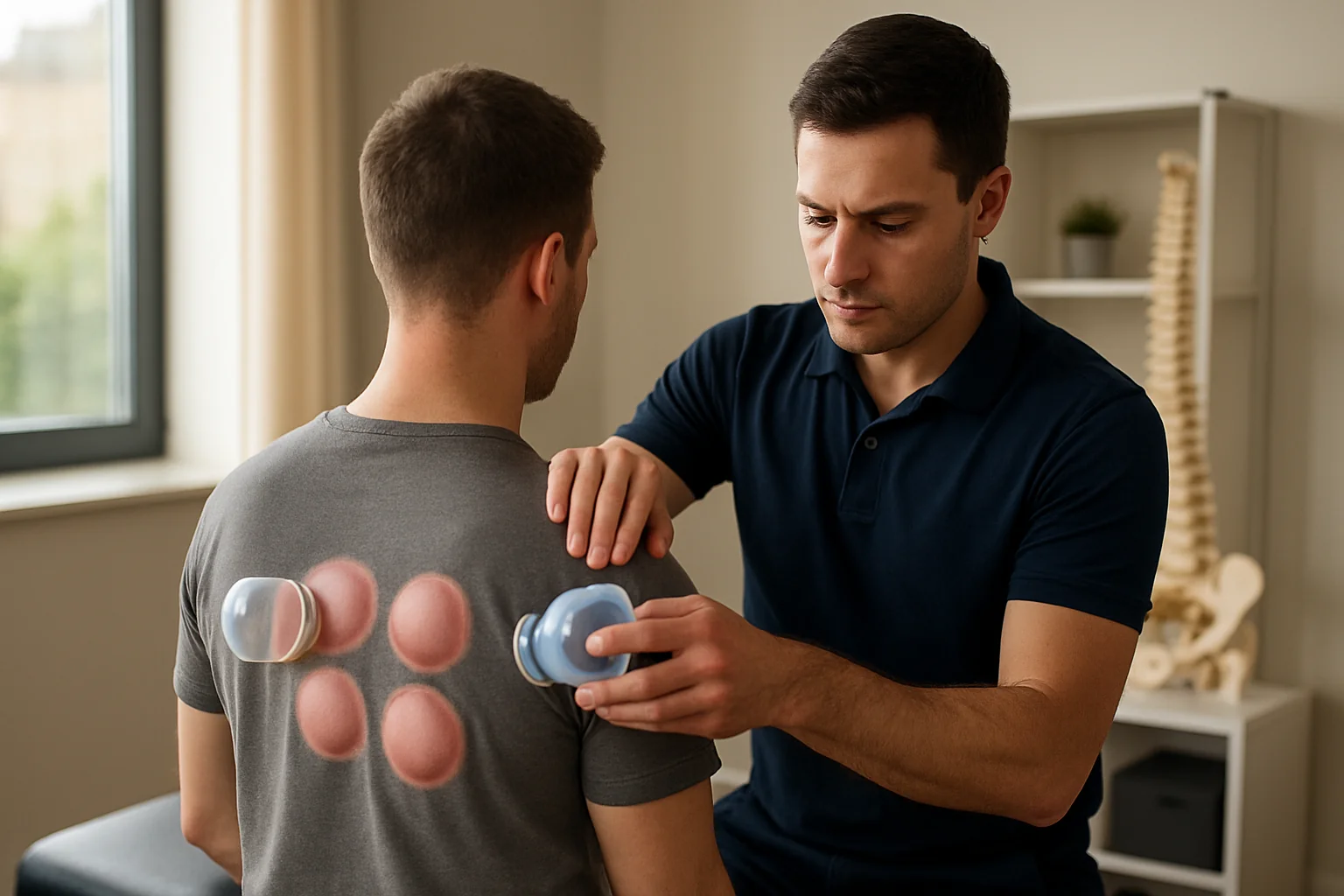
What Cupping Actually Does to Tissue
Understanding the timeline starts with understanding the mechanism. Cupping uses suction — either from silicone cups or vacuum-sealed cups — to lift and decompress soft tissue rather than compress it. Most manual therapy pushes into tissue; cupping pulls it apart. That distinction matters clinically.
The primary effects are myofascial decompression, increased local blood and lymphatic circulation, and fascial plane separation. When suction is applied, the superficial and deep fascial layers are lifted away from each other. In areas where those layers have become adhered — due to repetitive strain, old injury, or chronic overuse — this separation creates a mechanical and neurological response that signals the nervous system to down-regulate the tissue tension in that area.
The immediate sensation of relief after cupping — looser tissue, reduced pain, improved range of motion — is real. It's not placebo. But it reflects a neurological and circulatory change, not a permanent structural correction. How long that relief lasts, and whether it becomes permanent, depends on what's driving the restriction in the first place.
The Two Scenarios Where Cupping Works Differently
Acute Muscle Tension and Overuse
For someone dealing with muscle tightness from a recent strain, overtraining, or sustained postural load — the kind of tension that builds up in the upper traps from desk work, or in the thoracic paraspinals from heavy lifting — cupping tends to produce fast results. One to three sessions will typically produce noticeable change that holds between visits. The tissue isn't structurally compromised; it's just in a state of sustained contraction. Cupping breaks that cycle efficiently.
In these cases, the results from a single session often last several days. With a few sessions combined with whatever behavioral change addresses the cause — better movement breaks, load management, postural correction — the problem resolves without requiring ongoing maintenance.
Chronic Fascial Restriction
Chronic restriction is a different situation. When a tissue has been restricted for months or years — from an old injury that never fully healed, from repetitive loading that progressively built up scar tissue, or from long-standing postural changes — the fascial adhesions are denser and more organized. A single cupping session will produce temporary relief. The tissue is decompressed, circulation improves, and the patient feels better. But the structural adhesion hasn't been fully addressed, and the relief fades as the tissue settles back into its familiar pattern.
In these cases, four to eight sessions is a more realistic timeline for lasting change — assuming sessions are paired with appropriate spinal or soft tissue work that addresses the underlying mechanical driver. Cupping alone won't correct a chronic restriction if the joint mechanics or movement patterns generating that restriction remain unchanged.
Why Cupping Works Best as Part of a Broader Plan
This is where most people's experience with cupping diverges from optimal results. Getting cupping at a spa or standalone massage session isn't the same as getting it as part of a structured treatment plan that includes spinal assessment, joint mobilization, and rehabilitation.
Here's why that matters: most soft tissue restriction — particularly in the thoracic spine, cervical spine, and posterior hip — exists because the joints underneath are restricted. The muscle tension is the body's protective response to joint dysfunction. If you release the surface tissue without addressing the joint, the muscle tightens back up. Sometimes within hours.
The correct sequence is joint first, then soft tissue. When we combine spinal adjustment or mobilization with cupping, the soft tissue doesn't have to work as hard to protect a compromised joint, so the cupping effects last considerably longer. This is the real question patients should ask any provider: what is the cupping treating, and what is it paired with?
If you're curious about how chiropractic care works on a broader timeline, this post on how long chiropractic takes to work covers why the first few visits look different from the middle and end of a treatment plan.
What to Expect After Your First Session
The marks cupping leaves — called petechiae or ecchymosis — look alarming if you've never seen them. They're not bruises from trauma. They're the result of stagnant blood and metabolic waste being drawn to the surface of the tissue. Darker marks indicate more restricted tissue; lighter marks suggest the tissue was more mobile to begin with. They typically fade within three to seven days and don't indicate injury.
Most patients feel a significant reduction in tissue tension immediately after a cupping session. Some feel mild soreness 12 to 24 hours later — similar to what follows a deep tissue massage — as the tissue responds to the mechanical input. Hydration after a session is important; the increased circulation moves metabolic byproducts and adequate water helps clear them efficiently.
What you should not expect is that one session solves a problem that developed over months. A single session is diagnostic as much as it is therapeutic — it tells us how the tissue responds, how long the relief holds, and what the underlying tissue quality is like. That information shapes the rest of the plan.
Conditions That Respond Well to Cupping at QLC
Cupping is not appropriate for every patient or every presentation. The conditions where I find it most clinically useful are:
- Thoracic and lumbar paraspinal tightness, particularly when it limits spinal mobility
- Upper trapezius and levator scapulae tension contributing to neck pain or headaches
- Iliotibial band and gluteal restriction in patients with hip or knee complaints
- Restricted thoracolumbar fascia in patients recovering from lower back episodes
- Posterior shoulder and rotator cuff tension, especially after overuse or strain
Cupping is not appropriate over open skin, active inflammation, varicose veins, or on patients taking blood thinners. The evaluation before beginning care identifies whether cupping is a good fit for a given patient's presentation.
A Realistic Timeline by Condition Type
Acute Tension (Recent Onset, No Structural History)
Most patients notice meaningful improvement after one to two sessions. Three to four sessions with the appropriate spinal care typically resolves the complaint, assuming the mechanical driver is also addressed. Maintenance cupping may be appropriate every four to six weeks if the patient's work or training creates recurrent loading on the same tissue.
Subacute Restriction (Weeks to a Few Months)
Three to five sessions is a reasonable expectation. The tissue is more restricted than in the acute case but hasn't had time to fully reorganize. Most patients in this range notice a clear progression — each session holds longer than the last — which is the indicator that the treatment plan is working.
Chronic Restriction (Months to Years)
Six to ten sessions is a realistic range, though some presentations require more. The key indicator isn't session count — it's whether the relief interval between sessions is lengthening. If session three holds for two days, session five holds for five days, and session eight holds for two weeks, the treatment is progressing. If the relief is not lengthening, something in the plan needs to change — either the cupping technique, the pairing with other therapies, or the load the patient returns to between sessions.
For patients managing long-standing soft tissue problems alongside chronic spinal issues, this post on chiropractic care for chronic pain is relevant — the principles of how chronicity changes the treatment approach apply to soft tissue work as well.
What "Working" Actually Means
This is worth addressing directly, because patients often conflate two different outcomes. The first is symptom relief: the tissue feels looser, the pain is reduced, range of motion improves. Cupping typically produces this quickly. The second is resolution: the problem doesn't come back between sessions, and eventually doesn't require ongoing treatment at all.
The goal is always resolution, not management. A treatment approach where the patient needs cupping every two weeks indefinitely just to stay functional is not a success — it's a maintenance pattern for a problem that hasn't been identified at its source. When the plan is working correctly, the sessions become less frequent as the tissue holds better, and eventually the patient is discharged with the tools to self-manage.
If you've had cupping elsewhere and felt temporary relief but no lasting change, that's worth discussing at an evaluation. It's usually a sign that the structural driver — the joint restriction or movement pattern generating the soft tissue tension — hasn't been identified and treated.
If you want to understand more about what the intake and assessment process looks like before any treatment begins, this post on what to expect at your first chiropractic visit covers how we evaluate before recommending any specific therapy.
Serving Overland Park and Johnson County
We see patients from Overland Park, Leawood, Lenexa, Olathe, Prairie Village, and Shawnee. Cupping is one of several soft tissue tools we use at QLC — alongside Graston Technique, joint mobilization, and spinal adjustment — depending on what the evaluation identifies as the appropriate approach for a given patient's problem.
If you're dealing with this and want a clear plan, the next step is a proper evaluation. At Quality Life Chiropractic in Overland Park, we focus on identifying the root issue and building a structured plan to fix it.
Frequently Asked Questions
How many cupping sessions do I need to see results?
It depends on the acuity and chronicity of the problem. For recent muscle tension, one to three sessions often produces lasting relief. For chronic fascial restriction that has been building for months or years, four to eight sessions paired with spinal care is a more realistic expectation. The indicator that treatment is progressing is whether the relief interval between sessions gets longer with each visit.
Why did my cupping marks come back darker than last time?
Cupping mark color reflects the degree of circulatory stagnation and tissue restriction in that area. Darker marks on repeat visits often mean the tissue has been reloaded — from work, training, or posture — between sessions and the restriction has returned. It can also indicate that the underlying joint dysfunction driving the soft tissue tension hasn't been fully resolved. This is useful clinical information and worth discussing with your provider.
Can I get cupping at the same visit as an adjustment?
Yes, and that's often the most effective sequence. At QLC, cupping is typically performed as part of a broader visit that may include spinal adjustment or mobilization, Graston Technique, or rehabilitation exercises. Combining joint work with soft tissue work in the same session tends to produce better results than either alone, because the joint and the soft tissue around it are treated together.
Is cupping painful?
The suction sensation is unfamiliar if you've never had it, but most patients describe it as pressure rather than pain. Areas with significant restriction can feel more intense because the tissue has less give. The marks left afterward look worse than they feel — they're not painful to touch for most patients, and they fade within a few days.
Does Quality Life Chiropractic see patients from outside Overland Park?
Yes. We regularly see patients from Leawood, Lenexa, Olathe, Prairie Village, Shawnee, and throughout Johnson County, KS.