
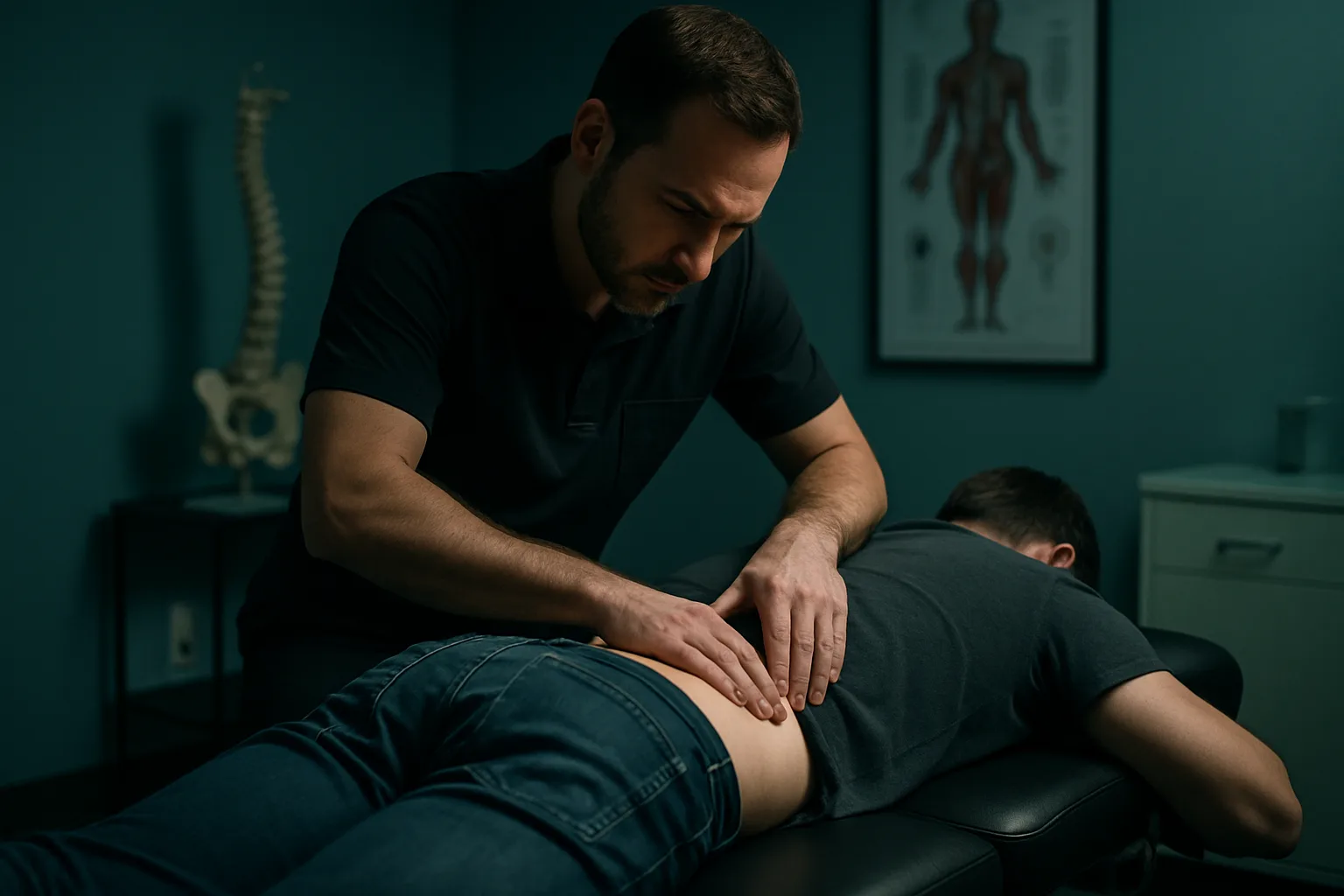
Why Sciatica Sometimes Feels Worse After an Adjustment
Sciatica isn't a single condition — it's a symptom pattern that can have several distinct sources. The most common are a lumbar disc herniation compressing a nerve root, piriformis muscle compression of the sciatic nerve in the buttock, sacroiliac joint dysfunction, or lumbar facet joint irritation. Each of these responds differently to spinal adjustment, and each has a different expected post-treatment response curve.
When adjustment mobilizes a joint that has been restricted and loaded in a fixed position for weeks or months, the surrounding soft tissue reacts. Muscles that had adapted to the restriction suddenly encounter movement again. Facet joint capsules are stretched. The mechanical forces around the lumbar spine shift. This can produce soreness in the short term even when the underlying change is beneficial.
The same way a muscle sore after a workout isn't evidence that the workout was harmful, post-adjustment soreness isn't inherently evidence that the adjustment was harmful. The critical distinction is whether what's worsening is the musculoskeletal soreness component — the lower back, the surrounding muscles — or the neurological component — the leg symptoms themselves, specifically the numbness, tingling, or weakness that travels down the sciatic distribution.
What Post-Adjustment Worsening Is Normal
Increased Local Back Soreness for 24–48 Hours
After lumbar or sacroiliac adjustment — particularly in the first few visits — it's common to feel more soreness in the lower back, hip, or upper buttock for 24 to 48 hours afterward. This is a tissue response to restored movement. Think of it as the price of admission for mobilizing a joint that's been stuck in a fixed position: the surrounding muscles and ligaments need time to adapt to the new range of motion.
This soreness should feel primarily like muscular tightness or aching — not like an intensification of the nerve symptoms into the leg. If it resolves within 48 hours and you feel meaningfully better before the next visit, that's generally within the range of a normal early treatment response.
Leg Symptoms That Shift Location
One of the more counterintuitive things that happens with sciatica during treatment is centralization. This is when symptoms that were previously felt deep in the calf or foot begin moving proximally — up toward the thigh or buttock, closer to the spine. The pain or tingling may intensify near the low back while simultaneously becoming less intense in the lower leg.
Many patients experience this as "getting worse" because the spinal area suddenly hurts more. But centralization is a positive clinical sign — it indicates that nerve root compression is reducing, and the affected nerve is decompressing from the distal end inward. A provider who understands sciatica recovery will be watching for centralization specifically, because it's one of the strongest early indicators that the approach is working.
If you're unsure whether what you're experiencing is centralization or actual worsening, the question to ask is: are my foot and lower calf symptoms less intense, even if my hip and buttock feel worse? If so, that's centralization. This post on what's normal after a sciatica adjustment covers centralization in more detail.
Increased Fatigue or Sensitivity After Treatment
Adjustment stimulates a significant volume of mechanoreceptor input to the nervous system. Some patients feel energized afterward; others feel fatigued or mildly hypersensitive to sensation for several hours. This is a normal neurological integration response and isn't predictive of whether the treatment is helping or hurting. It typically resolves within a few hours and doesn't indicate that anything harmful occurred during the visit.
What Post-Adjustment Worsening Is Not Normal
Neurological Symptoms That Are Consistently Deeper After Each Visit
This is the key distinction. If your leg numbness is progressively extending further into the foot after each adjustment — or if the tingling is spreading to a new area of the leg that wasn't previously involved — that's a directional change that needs attention. Some fluctuation in leg symptoms early in care is expected. A consistent trend of the neurological component deepening rather than improving across two to three weeks is not something to work through.
The goal of care is a measurable improving trend, not progressive neurological involvement. If your provider isn't tracking this explicitly — asking about leg symptoms at every visit, noting whether they're centralizing or peripheralizing — that's worth raising directly.
Pain That Doesn't Recover Between Visits
Early in care, post-adjustment soreness should resolve before the next visit. If you're still significantly worse from the previous visit when you arrive for the next one — and each visit adds another layer of pain without any window of improvement — the current approach isn't producing a beneficial response. This is different from gradual, slow improvement; it's an absence of any recovery period. It suggests the treatment frequency, technique, or diagnosis needs to be reconsidered.
New Symptoms That Weren't Present Before
Adjustment should not produce symptoms in areas that were completely uninvolved before care started. New bilateral leg involvement when you only had one-sided sciatica, new upper extremity symptoms, or new areas of numbness unrelated to your original presentation are reasons to pause and evaluate rather than attribute to normal treatment response.
Bowel or Bladder Changes
Any change in bowel or bladder function — difficulty urinating, incontinence, or numbness in the inner thighs and groin area — is a medical emergency regardless of whether you've recently had chiropractic treatment. This is cauda equina syndrome, involving compression of the lowest nerve roots in the lumbar canal. It requires emergency evaluation, not continued care.
The Diagnosis Is What Determines the Response
Most post-adjustment worsening that isn't due to a clear warning sign comes down to one underlying issue: treatment that started before the source of the sciatica was clearly identified.
When the evaluation establishes which structure is generating the nerve involvement — a specific lumbar disc level, the piriformis, the SI joint — the technique, loading direction, and expected response are all calibrated to that structure. The predictability of recovery goes up substantially when care is built around a specific diagnosis rather than applied to "sciatica" as a generic category.
When that diagnostic foundation isn't there, post-adjustment responses become harder to interpret. You don't know if the soreness is from mobilizing the right structure in the right direction, or from loading a structure that shouldn't be loaded at all right now. That ambiguity is exactly what leads patients to spend weeks wondering whether their pain is supposed to get worse before it gets better.
If you've been wondering whether the chiropractic approach you're currently in is actually matched to what's causing your sciatica, this post on whether a chiropractor can make sciatica worse covers the specific clinical scenarios where that's a real concern.
Not sure if your response to care is normal?
If your sciatica pain is consistently worse after each chiropractic visit, or you can't tell whether you're improving, a second-opinion evaluation will give you a clear read. We identify the specific source of the nerve involvement, explain what we find, and tell you honestly whether your current approach makes sense. No obligation to switch providers.
Book a Second-Opinion Evaluation →What a Proper Sciatica Evaluation Looks Like Before Treatment Begins
The reason post-adjustment worsening is so often confusing is that many patients begin treatment without a clear picture of what's actually causing their sciatica. Here's what a thorough evaluation should establish before the first adjustment:
- A detailed symptom history — onset, mechanism, affected leg, specific quality of symptoms, positions that worsen or relieve them
- Neurological screening — dermatomal sensation, myotomal strength at L4, L5, S1, deep tendon reflexes
- Orthopedic provocation testing — straight leg raise, slump test, FABER, piriformis provocation — to differentiate disc from piriformis from SI joint as the primary driver
- Directional preference testing — identifying which lumbar movements centralize or peripheralize symptoms, which guides the technique and loading direction used in care
- Palpation of lumbar and sacroiliac segments to identify motion restriction patterns
Imaging isn't always the first step. But when neurological signs are present — specific weakness, diminished reflexes, dermatomal numbness — or when symptoms have been present more than six to eight weeks without improvement, imaging confirms the structural cause and removes the guesswork from how to approach treatment.
How Recovery Should Progress — And What to Watch For
A well-matched treatment approach for sciatica produces a measurable improving trend within the first two to three weeks. That doesn't mean every individual day is better than the last — recovery from nerve involvement isn't linear. But across that window, the overall arc should be moving in a positive direction: leg symptoms gradually centralizing, soreness after visits becoming less intense, and pain-free windows between visits becoming longer.
The question isn't whether a single visit made you feel worse. It's whether the direction of change over the first two to three weeks is clearly moving the right way.
Full recovery from sciatica — particularly if numbness or weakness was involved — takes longer than most patients expect. Most see meaningful improvement in leg symptoms within two to four weeks of consistent, diagnosis-guided care. Complete resolution, especially of neurological symptoms, often takes six to twelve weeks or more, depending on how long the nerve was under compression before treatment began. This post on how long sciatica lasts walks through the realistic timeline in detail.
When to Stop, Reassess, or Seek a Different Evaluation
You don't need to tolerate progressive worsening in hopes it'll eventually turn around. If any of the following are true after two to three weeks of care, it's appropriate to request a reassessment — either with your current provider or with a second opinion:
- Neurological symptoms in the leg are consistently more intense or further into the foot after each visit, with no recovery window
- You haven't had a single visit that produced even a temporary improvement in leg symptoms
- The original diagnosis was never clearly explained to you — you were told you had "sciatica" without identification of the specific structure causing it
- Treatment frequency is being increased rather than adjusted based on your response
These aren't reasons to give up on chiropractic care for sciatica. They're reasons to ensure the specific approach is calibrated to the specific cause. A structure-first evaluation often reveals that the right technique or the right direction of treatment produces a completely different response than what was tried before.
Serving Overland Park and Surrounding Johnson County
If you're in Overland Park, Leawood, Lenexa, Olathe, or elsewhere in Johnson County and your sciatica is getting worse after chiropractic visits — or you're just not sure what to make of the response you're having — the starting point is a thorough evaluation that identifies the source of the nerve involvement before any further treatment. Most patients who come in reporting that their care isn't working have never had the specific cause of their sciatica clearly established. That distinction changes the entire approach.
If you're dealing with this and want a clear plan, the next step is a proper evaluation. At Quality Life Chiropractic in Overland Park, we focus on identifying the root issue and building a structured plan to fix it.
Frequently Asked Questions
Why does my sciatica pain get worse after a chiropractic adjustment?
A temporary increase in pain after an adjustment is usually a normal tissue response — joints that have been restricted are being mobilized, and the surrounding soft tissue reacts. This typically peaks within 24 hours and resolves within 48. What separates a normal response from a concern is the direction: if pain is increasing progressively across multiple visits with no recovery window in between, that needs to be reassessed rather than worked through.
How long should sciatica pain be worse after an adjustment before I'm concerned?
A post-adjustment flare that lasts 24 to 48 hours is generally within normal range for early care. If increased pain persists beyond 72 hours, or if the neurological component — numbness, tingling, or weakness into the leg — is consistently more intense after each visit with no period of improvement, that's a signal to reassess the approach rather than continue the same treatment.
What's the difference between a normal post-adjustment flare and actual worsening?
A normal flare is primarily felt as soreness in the lower back and soft tissue — not as a deepening of the nerve symptoms themselves. It improves between visits and shows a general improving trend over the first two to three weeks. Actual worsening looks different: neurological symptoms (numbness, tingling, weakness) are more intense or further into the leg after each visit, and there's no meaningful recovery between sessions.
Should I continue chiropractic care if my sciatica pain is worse after treatment?
That depends on what's getting worse and for how long. Local soreness that resolves within 48 hours is expected and not a reason to stop. Neurological symptoms that are consistently deepening across multiple visits — increasing numbness or weakness, symptoms spreading further into the foot — are a reason to pause and reassess the diagnosis and approach before continuing. The goal of care is a measurable improving trend, not progressive worsening.
Does Quality Life Chiropractic treat sciatica patients from outside Overland Park?
Yes. We regularly see patients from Leawood, Lenexa, Olathe, Prairie Village, Shawnee, and throughout Johnson County, KS.