
Why Back Pain Keeps Coming Back
The most common version of back pain I see isn't the dramatic kind — it's the kind that's been present for months or years at a low-to-moderate level, flares up occasionally, and gets managed with the same rotation of remedies. People get used to it. They stop expecting it to go away.
This pattern almost always has the same explanation: the underlying structural issue was never identified or addressed. The remedies reduced the pain signal without changing what was generating it.
Back pain doesn't come from thin air. It comes from something structural — a joint that's restricted and not moving properly, a disc under abnormal load, a muscle system that's stopped stabilizing effectively. When that structure is irritated, it produces a pain signal. When you reduce the irritation temporarily with ice or ibuprofen, the signal quiets. When the underlying issue is unchanged, the irritation rebuilds and the signal returns.
This is not a failure of the remedies. Ice and over-the-counter anti-inflammatories have a role in acute pain management. The problem is using them as a long-term strategy when the actual issue is structural and hasn't been evaluated.
What "Structural" Actually Means
When I use the word structural, I mean something specific. The lumbar spine is made up of bones, joints, discs, ligaments, and muscles that all have to work together under load. When any component in that system isn't functioning the way it should, the rest of the system compensates — and compensation creates abnormal loading patterns that eventually produce symptoms.
Restricted Facet Joints
The facet joints at each spinal level guide movement and share the load-bearing responsibility with the discs. When a facet joint loses normal mobility — from deconditioning, repetitive posture, or minor cumulative injury — it stops doing its job. The joints around it are forced to compensate. Over time, the over-loaded segment becomes sensitized, and activities that were never a problem before start producing pain.
Disc Involvement
Lumbar discs act as shock absorbers between the vertebral bodies. When a disc is under abnormal load — from a restricted adjacent joint, a stabilization deficit, or cumulative compression — it can become sensitized, dehydrate prematurely, or develop annular changes that alter how the spine moves under load. Disc-related back pain tends to be position-dependent: worse sitting, better standing, or vice versa, depending on where in the disc the issue is.
Stabilization Deficit
The deep stabilizing muscles — particularly the multifidus and transverse abdominis — are supposed to create a stable base for every movement the spine makes. In people who've had back pain for any length of time, these muscles are almost always underperforming. The body learns to avoid loading structures that are painful, and the stabilizers quietly stop firing at the level they should. The spine ends up relying more on passive structures — bone, ligament, disc — that aren't designed to carry that load indefinitely.
Hip and Pelvis Mechanics
The lumbar spine and hips are mechanically connected. When hip mobility is restricted — tight hip flexors, reduced internal rotation, limited extension — the lumbar spine has to compensate with increased motion through its own segments. A patient whose back pain is really being driven by hip restriction often spends years treating the back without ever addressing the pelvis. The spine keeps getting overloaded because the hips aren't doing their share of the work.
The Problem with "Just Rest It"
Rest is appropriate in the first 24 to 72 hours of a significant acute injury. After that, prolonged rest tends to make structural back pain worse, not better. Here's why: the stabilizing muscles that protect the spine need movement to stay active. The joints need regular motion to maintain their nutrition and mobility. Lying still for days reduces pain acutely because it eliminates loading — but it also allows the stabilizers to further disengage and the joints to stiffen further.
The goal isn't to find a position where nothing hurts. The goal is to restore the ability of the spine to handle load normally. That requires progressively reloading the system, not avoiding it.
What a Proper Evaluation Finds
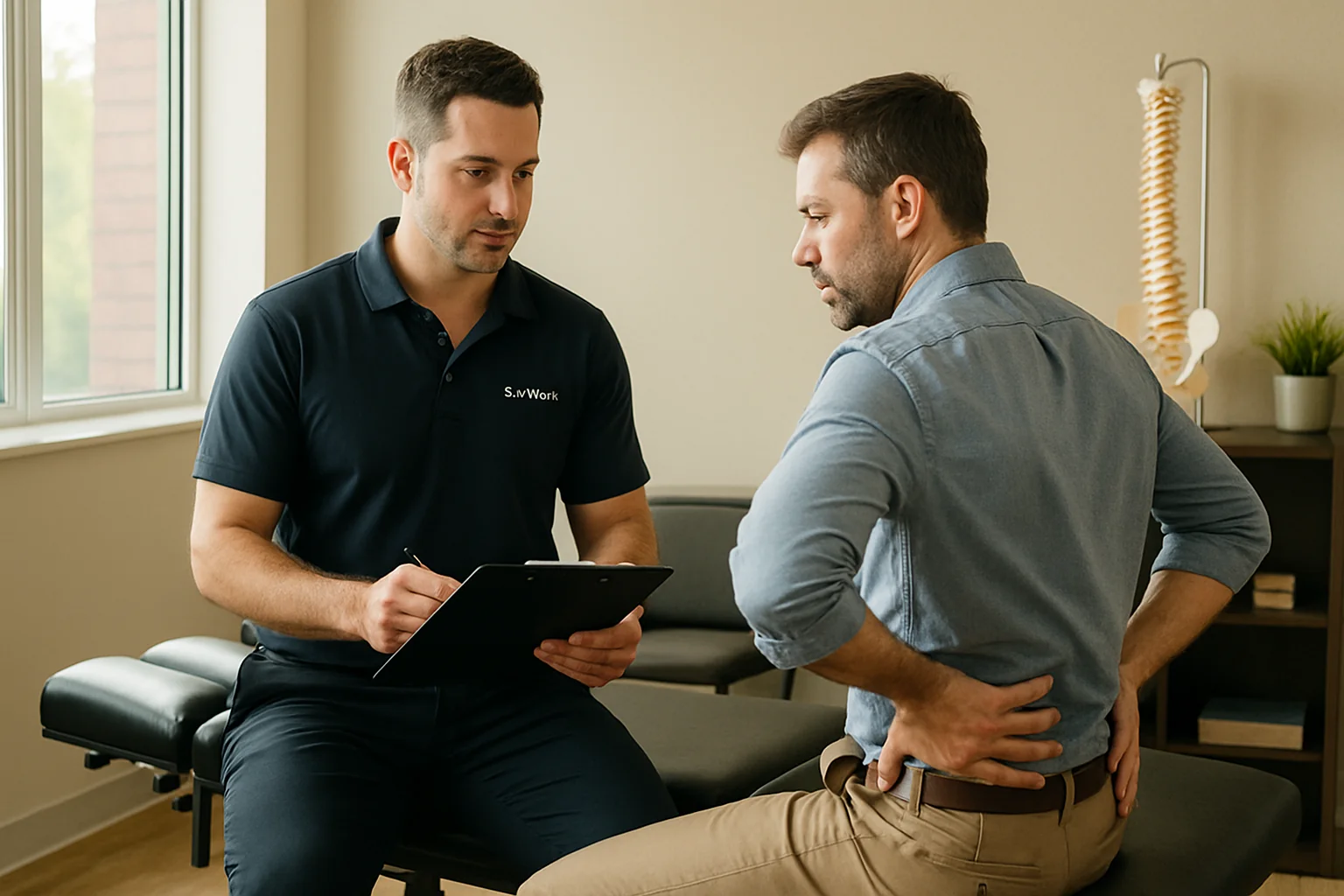
When someone comes in looking for back pain relief in Overland Park, the evaluation is designed to get past the symptom and identify the structural driver. That involves several components:
- Lumbar range of motion — which movements reproduce, reduce, or worsen the pain
- Segmental joint assessment — working through each spinal level to identify restriction and provocation
- Disc provocation testing — orthopedic tests that load the disc in specific ways to determine if it's involved
- Neurological screening — reflexes, dermatomal sensation, and myotomal strength if any radicular symptoms are present
- Hip mobility assessment — because hip restriction is a frequent unaddressed contributor to lumbar pain
- Stabilizer activation testing — whether the deep system is engaging appropriately under load
The outcome of this evaluation isn't a general diagnosis of "back pain." It's a specific structural picture: which joints are restricted, whether the disc is involved, how the hips and pelvis are contributing, and where the stabilization system has broken down. That picture is what allows a treatment plan to target the right things in the right order.
What Treatment Actually Involves
There's no universal back pain treatment protocol that works for everyone. What works depends entirely on what the evaluation finds. That said, most structural back pain cases involve some combination of the following:
Joint Mobilization and Adjustment
Restoring normal motion to restricted lumbar and pelvic segments. This typically produces the fastest early symptom relief — the "locked up" sensation eases, range of motion improves, and pain intensity often decreases noticeably within the first several visits. But early relief is a signal that the system is responding, not that the problem is solved.
Soft Tissue Work
Addressing the muscle guarding and compensatory tension patterns that accumulate around dysfunctional joints. The QL, hip flexors, and piriformis are commonly involved in lumbar and pelvic pain patterns and respond well to targeted manual work when addressed as part of a structured plan.
Stabilization Rehabilitation
Retraining the deep stabilizers to engage under load. This is the component most often skipped — and it's the one most responsible for whether the problem comes back. Patients who get joint work without stabilization rehab often see their pain return within weeks because the underlying muscular deficit hasn't been addressed. At QLC, stabilization work is built into the care plan from the start, not added as an afterthought.
Progressive Loading
Gradually reintroducing the specific activities and loads that have been causing pain, in a controlled and progressive way. The goal is to rebuild normal tolerance — not to avoid loading indefinitely.
Realistic Expectations for Back Pain Resolution
Most patients with structural back pain notice meaningful improvement within the first two to four weeks of care. The pain becomes less frequent, less intense, and less disruptive. That's early progress, and it matters — but it's not the same as resolution.
Resolution means the underlying structural issue has been corrected and the system has been restabilized. How long that takes depends on how long the problem has been present, how many compensations have stacked on top of the original issue, and how consistently the care plan is followed.
A back problem that's been building for six months takes longer to correct than one that started three weeks ago. The structural changes that accumulate over time — joint hypomobility, disc changes, stabilizer inhibition — don't reverse overnight. What you should expect is steady, measurable progress on a clear timeline, not open-ended care with no defined endpoint.
For more on how the timeline of care works with pain that's been present for an extended period, this post on chiropractic care for chronic pain covers how the approach shifts when a problem is well-established versus acute.
When Back Pain Becomes a More Urgent Problem
Most back pain, while uncomfortable and disruptive, is not medically urgent. There are patterns, however, that warrant earlier attention:
- Pain that radiates down one or both legs — especially below the knee
- Numbness, tingling, or weakness in the leg or foot
- Pain that is significantly worse at night and not position-dependent
- Loss of bowel or bladder control (this is a medical emergency — go to an ER)
- Back pain following significant trauma
- Back pain with unexplained weight loss or fever
If any of those are present, the evaluation needs to happen promptly and may involve imaging to rule out serious pathology. The majority of people searching for back pain relief don't have any of these, but it's worth knowing the red flags.
If back pain has started producing leg symptoms — even something mild like occasional aching in the glute or thigh — this post on chiropractic for sciatica explains how that pattern is evaluated and what the realistic options are.
What I See in Practice
The Patient Who's Managed It for Years
This is the most common presentation. The back pain has been there at some level for so long that it feels normal. They know which activities to avoid, which positions help, and which remedies get them through a flare. When we evaluate, there are usually multiple layers: a primary joint restriction that's been there the longest, compensatory restrictions that developed around it, and stabilizers that have been checked out for years. These cases take longer, but they also respond well once the full picture is clear and the plan targets the right things in the right order.
The Patient Whose Pain Started After a Specific Event
A lifting incident, an awkward movement, sleeping in a strange position. The pain started clearly and hasn't gone away. These cases often resolve faster because the underlying structures were functioning well before the event, and the problem is more discrete. The evaluation identifies the specific segment involved, the care plan targets it directly, and most patients see significant improvement within a few weeks. The key is not waiting too long — acute structural injuries managed early tend to resolve more completely than ones that are allowed to develop compensation patterns over months.
The Patient Who Gets Better and Then Worse Again
They respond well initially, improve significantly, and then have a setback — sometimes after a specific activity, sometimes without any clear cause. This pattern usually indicates that the stabilization component wasn't fully addressed before the care plan ended. The joints are moving better, but the deep muscular system isn't providing consistent protection under variable load. When this pattern shows up, the treatment shifts to focus more heavily on stabilization and progressive loading to build durable improvement. For more on why back pain flares up predictably with certain postures and activities, this post on lower back pain from sitting all day explains the biomechanics in detail.
The goal isn't to find something that temporarily quiets the pain. It's to understand why the pain keeps coming back — and to actually correct it.
Serving Overland Park and Surrounding Communities
If you're looking for back pain relief in Overland Park, Leawood, Lenexa, Olathe, or the greater Johnson County area, the starting point is a thorough structural evaluation — not a guess. Most people dealing with recurring back pain have never had the underlying structural issue properly identified. That evaluation is what makes it possible to build a plan that actually targets the right problem.
If you're dealing with this and want a clear plan, the next step is a proper evaluation. At Quality Life Chiropractic in Overland Park, we focus on identifying the root issue and building a structured plan to fix it.
Frequently Asked Questions
How is chiropractic care different from massage or physical therapy for back pain?
Chiropractic focuses specifically on the mechanical function of the spine and pelvis — joint mobility, segmental alignment, and the neurological system that controls movement. Massage addresses soft tissue tension and can provide significant temporary relief, but doesn't correct joint restriction. Physical therapy typically focuses more on exercise rehabilitation. In many cases these approaches complement each other, but chiropractic is specifically designed to identify and correct the structural joint issues that are often the primary driver of recurring back pain.
How many visits does it take to get back pain relief?
Most patients notice meaningful improvement within the first two to four visits. Full resolution — where the underlying issue is corrected and the system is restabilized — typically takes several weeks to a few months depending on how long the problem has been present. At QLC, care plans have a defined structure and timeline. You should know what to expect and be able to measure your progress.
Is back pain relief from chiropractic care permanent?
When the structural issue is fully corrected and the stabilization system is properly retrained, recurrence rates drop significantly. That said, some people are more prone to recurring joint restriction based on their activity levels, posture demands, and how their nervous system responds to load. Periodic maintenance visits — once every four to eight weeks — help catch early restriction before it becomes symptomatic. Whether that's necessary depends on the individual.
Should I see a chiropractor or a doctor first for back pain?
For most mechanical back pain — pain that is position-dependent, aggravated by activity, and not accompanied by red flag symptoms — a chiropractic evaluation is a reasonable first step. Chiropractic can identify structural issues that imaging often misses or misattributes, and treatment can begin the same day as the evaluation. If there are red flag symptoms present (leg weakness, bowel or bladder changes, unexplained weight loss), see a medical doctor or go to an ER first.
Does Quality Life Chiropractic treat patients from outside Overland Park?
Yes. We regularly see patients from Leawood, Lenexa, Olathe, Prairie Village, Shawnee, and throughout Johnson County, KS.