
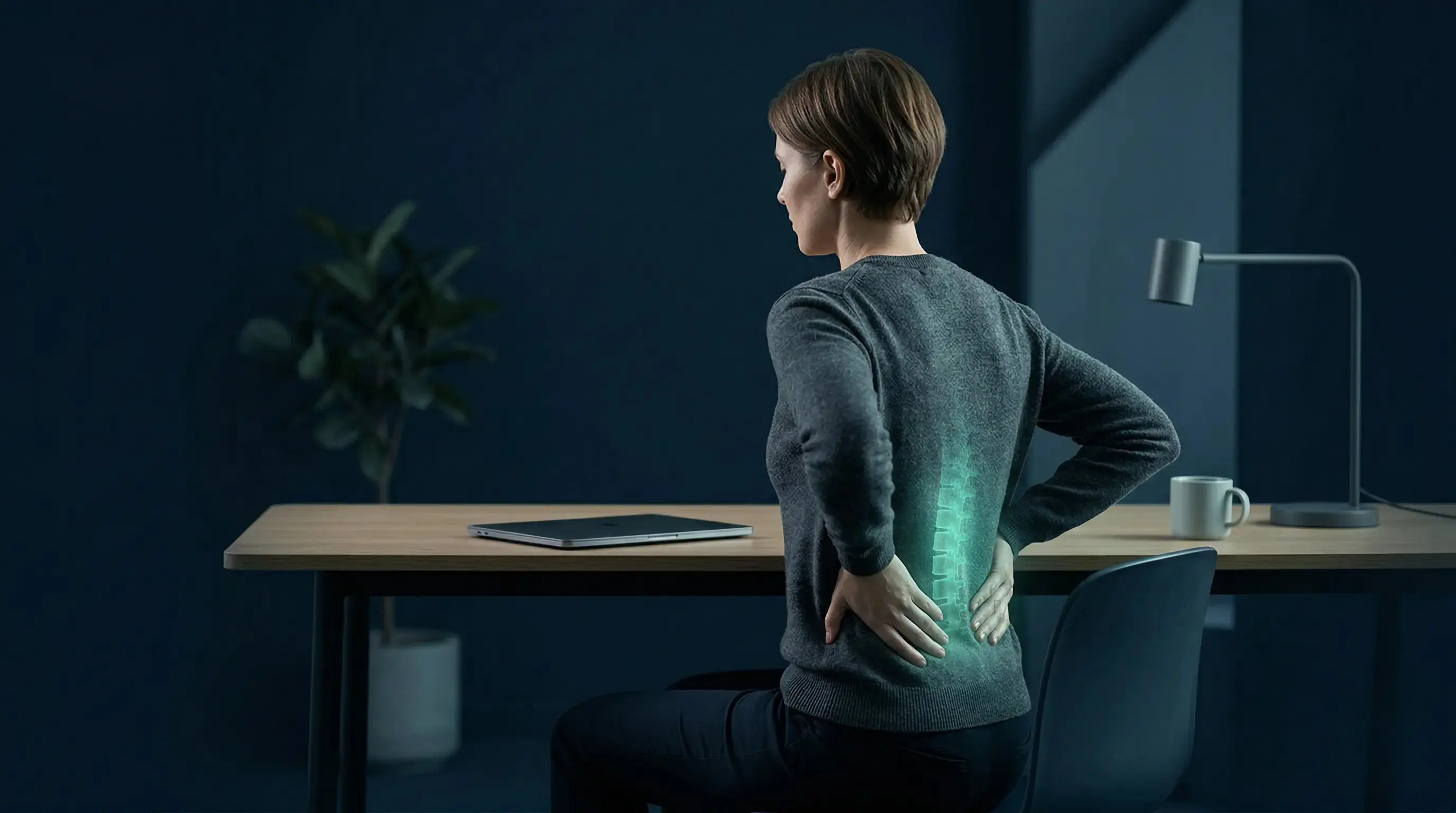
Why Sitting Loads the Lumbar Spine Differently Than Standing
When you stand, the lumbar spine has a natural lordotic curve — an inward arch — that distributes load efficiently across the vertebral bodies and facet joints. The muscles and ligaments around the spine share the work.
Sitting changes that geometry. The pelvis tilts posteriorly, the lumbar curve flattens, and load shifts forward onto the intervertebral discs. The posterior ligaments stretch. The deep stabilizing muscles disengage because they're no longer needed in the same way.
This isn't inherently harmful. A healthy lumbar spine handles sitting without issue for reasonable periods. The problem starts when joints are already restricted, discs are already sensitized, or the stabilizing system has been underperforming for a while. Sitting just amplifies what's already there.
The Structural Issues I Actually Find
When someone comes in telling me their back hurts after sitting all day, the evaluation almost always reveals one or more of these:
Lumbar Facet Joint Restriction
The facet joints in the lower back guide and limit motion. When they lose normal mobility — from deconditioning, minor injury, or just years of sustained sitting posture — they don't glide properly under load. Sitting compresses them into a position they can't accommodate well, and by mid-afternoon the surrounding tissue is inflamed and guarding. Standing up feels like you need to "unfold" because those joints are temporarily stuck.
Disc Load Sensitivity
Lumbar discs are under significantly more compressive and shear load during seated posture than standing. A disc that's mildly dehydrated, has a small annular tear, or is in the early stages of degeneration will tolerate standing but become symptomatic under sustained sitting load. This typically presents as a deep, central ache that worsens through the day and improves when you walk around.
SI Joint Dysfunction
The sacroiliac joints connect the spine to the pelvis. Sitting puts asymmetric load on them — especially if you cross your legs, lean to one side, or sit on a wallet. When one SI joint isn't moving properly, sitting creates a constant low-grade irritation that builds over hours. The pain is usually one-sided and located below the belt line, near the dimple of the low back.
Core Stabilization Deficit
The deep stabilizers — transverse abdominis, multifidus, pelvic floor — are designed to protect the lumbar spine under load. In people who sit for most of the day, these muscles are chronically underactive. They stop firing efficiently, and the spine relies more on passive structures (ligaments, disc, bone) to handle load. That works for a while. Eventually those passive structures get overloaded and produce pain.
Why "Sit Up Straighter" Doesn't Fix It
Posture matters, but it's overemphasized as the cause of sitting-related back pain. Here's why:
Most people can sustain "perfect" posture for about 15 minutes before fatigue sets in and they slump back to their default position. That's normal — it doesn't mean you're weak or undisciplined. It means sustained posture requires muscular endurance that most desk workers haven't specifically trained.
More importantly, correcting posture doesn't correct the underlying joint restriction or disc sensitivity. If the L4-L5 facet joint is restricted, sitting up straight still loads that joint in a way it can't tolerate. You'll feel better momentarily because you changed the load pattern, but the relief doesn't last because the root problem is still there.
The same applies to ergonomic setups. A good chair helps. A standing desk helps. But neither one addresses what's structurally wrong — they just change how the load is distributed across a system that already has a problem.
How to Tell If This Is Worth Getting Evaluated
Not every episode of back stiffness after a long day at the desk requires a clinical evaluation. But certain patterns suggest something structural that won't resolve with stretching and better posture alone:
- The pain is consistent — it shows up most days you sit for extended periods
- It's been gradually getting worse over weeks or months
- Standing up after sitting produces a sharp catch or requires a few seconds to straighten out
- The pain extends into your hip, glute, or leg
- Morning stiffness has started showing up alongside the sitting-related pain
- You've tried a standing desk, new chair, or stretching routine and the pattern hasn't meaningfully changed
If any of that sounds familiar, the issue is almost certainly structural — not behavioral. Changing your habits is still worthwhile, but it's not going to resolve a joint restriction or stabilization deficit on its own.
What an Evaluation Looks At
When someone comes in with this complaint, the evaluation is designed to identify which structure is actually driving the symptoms. That involves:
- Lumbar range of motion testing — which directions reproduce or worsen the pain
- Segmental joint assessment through each lumbar level and the SI joints
- Orthopedic provocation tests for disc involvement
- Hip mobility screening — because restricted hips force the lumbar spine to compensate
- Core stabilization assessment — can you actually recruit the deep stabilizers under load
- Neurological screen if pain radiates into the leg
The goal is a specific structural diagnosis, not a vague label like "low back strain." You need to know whether it's a facet restriction, a disc issue, SI joint dysfunction, or a combination — because each one has a different treatment approach and timeline.
What Treatment Typically Involves
Once the evaluation identifies the source, the care plan targets it directly:
Joint Mobilization or Adjustment
Restoring normal motion to restricted lumbar or SI joint segments. This is usually what provides the most noticeable early relief — especially the "locked up" sensation when standing after prolonged sitting.
Soft Tissue Work
Addressing the muscle guarding and tension patterns that develop around dysfunctional joints. The hip flexors, piriformis, and QL are frequently involved in sitting-related back pain and respond well to targeted manual work.
Core Stabilization Rehab
Retraining the deep stabilizers to fire effectively under load. This isn't about doing crunches or planks — it's about reactivating the specific muscles that protect the spine during sustained postures. This is what prevents recurrence.
Movement and Ergonomic Guidance
Specific recommendations for your sitting setup, movement breaks, and loading strategies throughout the day. These are supporting changes — they matter, but they work best when the underlying structural issue has been identified and treated first.
Realistic Expectations
If the primary driver is a straightforward facet restriction, most patients notice meaningful improvement within the first few visits. The "locked up" sensation when standing decreases, and pain through the day becomes less intense.
But if you've had this pattern for months or years, the structural issue has been building for a while. There are usually compensations stacked on top of compensations — restricted joints, weak stabilizers, tight hip flexors, altered movement patterns. Unwinding all of that takes a structured plan over several weeks, not a single adjustment.
The approach I take is to identify the primary driver, get that moving in the right direction, and then systematically address the contributing factors. You should expect to feel measurable progress early, with full resolution taking longer if the issue is well-established. For more on how that process works with pain that's been present for a while, this post on chiropractic care for chronic pain goes into the difference between acute and longstanding problems.
What I See in Practice
The Office Worker Who "Just Gets Stiff"
This is the most common version. They sit eight-plus hours a day, feel progressively stiffer through the afternoon, and stretch it out when they get home. It's been going on for so long they've accepted it as normal. When we evaluate, there's usually a clear facet restriction at L4-L5 or L5-S1, hip flexor tightness pulling the pelvis forward, and deep stabilizers that barely activate. The sitting isn't causing the problem — it's exposing a structural deficit that's been developing for years.
The Weekend Warrior Who Only Hurts on Mondays
Active on weekends — running, lifting, playing with kids. Feels great. Then Monday hits, they sit all day, and the back tightens up. The activity is actually keeping the system moving well enough to compensate, but the underlying restriction is still there. Sitting removes the movement that was masking it. These patients often respond quickly once the restriction is addressed because their overall conditioning is good.
The Person Whose Back Pain Turned Into Leg Pain
This is the one that warrants earlier attention. What started as mid-back or low-back stiffness from sitting has gradually developed a component of pain, tingling, or numbness that extends into the glute, thigh, or calf. That pattern suggests the disc is involved and the nerve root may be affected. Sitting compresses the disc further, which is why the leg symptoms often worsen in the chair. If you're noticing this progression, don't wait — the sooner the disc involvement is evaluated, the more conservative the treatment can be. If sciatica symptoms are part of the picture, this post on chiropractic and sciatica covers what to consider before starting treatment.
The question isn't whether sitting is bad for you. It's whether your lumbar spine has a structural issue that sitting is exposing — and whether that issue is being addressed or just managed.
Serving Overland Park and the Surrounding Area
If you're dealing with lower back pain from sitting in Overland Park, Leawood, Lenexa, Olathe, or anywhere in Johnson County, this is a pattern worth getting evaluated. Not because sitting is inherently dangerous — it isn't — but because persistent sitting-related back pain almost always has a structural explanation that can be identified and corrected.
If your sitting-related back pain also involves morning stiffness or neck tension, this post on waking up with neck pain covers how sustained posture can affect the upper spine as well.
If you're dealing with this and want a clear plan, the next step is a proper evaluation. At Quality Life Chiropractic in Overland Park, we focus on identifying the root issue and building a structured plan to fix it. If back pain is part of a bigger pattern, explore the full list of conditions we treat.
Frequently Asked Questions
Why does my lower back hurt only when I sit but not when I stand or walk?
Sitting flattens the lumbar curve and shifts load forward onto the discs while compressing the facet joints differently than standing. If there's a joint restriction or disc sensitivity, sitting amplifies it. Standing and walking distribute load more evenly and allow the stabilizing muscles to engage, which is why those positions feel better.
Will a standing desk fix my back pain?
It can help reduce symptoms by changing the load pattern, but it doesn't correct the underlying structural issue. If a facet joint is restricted or the deep stabilizers aren't firing properly, you'll likely develop a different set of compensations while standing. A standing desk is a useful tool — it works best alongside treatment that actually addresses the root cause.
How long does it take to fix back pain from sitting all day?
If the primary issue is a straightforward joint restriction, most patients feel meaningful improvement within the first few visits. If the pattern has been present for months or years with multiple contributing factors — weak stabilizers, tight hip flexors, disc involvement — expect a structured course of care over several weeks. Early progress is usually noticeable either way.
Should I stretch my lower back during the day?
Gentle movement breaks are helpful — standing, walking, and hip flexor stretches can reduce the sustained load. However, aggressive low back stretching can sometimes irritate an already sensitized structure. The right stretches depend on what's actually causing the pain, which is why an evaluation is more useful than a generic stretching routine.
Does Quality Life Chiropractic treat patients from outside Overland Park?
Yes. We regularly see patients from Leawood, Lenexa, Olathe, Prairie Village, Shawnee, and throughout Johnson County, KS.