
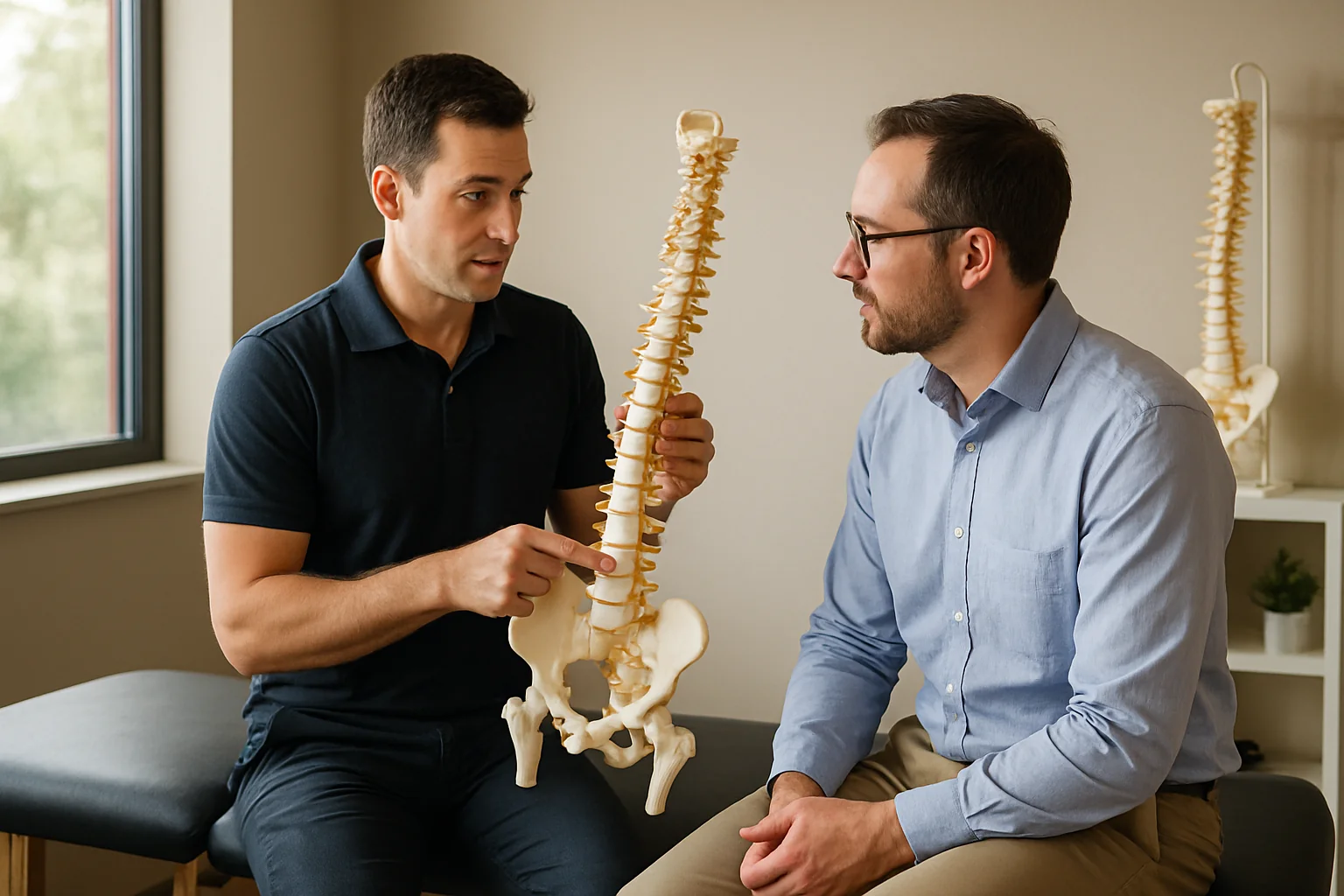
What a Disc Herniation Actually Is
Between each lumbar vertebra sits an intervertebral disc: a structure with a tough outer ring called the annulus fibrosus and a gel-like center called the nucleus pulposus. The disc functions as both a shock absorber and a spacer, allowing the vertebrae to move relative to each other while maintaining the height and integrity of the intervertebral foramen — the opening through which nerve roots exit the spine.
A herniation occurs when the nucleus shifts through a tear or weak point in the annulus and protrudes beyond its normal boundary. The terminology can be confusing because clinicians use several related terms. A bulge describes a broad, symmetric outward expansion of the disc — the annulus is intact but the disc extends beyond its normal footprint. A herniation describes a localized displacement of disc material through the annulus. A protrusion is a herniation where the base is wider than the displaced portion; an extrusion is one where the disc material extends further out than the base and may be partially separated from the disc itself.
These distinctions matter clinically because they affect where the disc material is pressing and how stable the situation is likely to be over time. But the distinction that matters most for treatment planning isn't the type of herniation — it's whether the herniation is actually compressing a nerve root, and if so, which one and how severely.
When a Disc Herniation Causes Symptoms — and When It Doesn't
This is the part of the conversation that gets skipped far too often: a significant number of people walking around without any back or leg pain have disc herniations visible on MRI. Studies of asymptomatic adults find disc herniations in a substantial percentage of the population, and that percentage increases with age. A herniation seen on imaging is a finding, not automatically a diagnosis. It becomes clinically meaningful when it correlates with the patient's specific pattern of symptoms.
When a herniated disc is pressing on a nerve root, it produces a fairly predictable pattern: pain, numbness, or tingling that radiates from the low back through the buttock and into the leg, following the pathway of the compressed nerve. This is radiculopathy — what most people recognize as sciatica. The specific leg pattern helps identify which disc level is involved (L4-L5 vs. L5-S1, for example), which informs both treatment approach and prognosis. To understand how this presentation differs from other causes of leg pain, see our overview of whether chiropractic works for sciatica.
A herniation without nerve root compression typically produces local back pain, stiffness, and pain that increases with sitting and forward bending — because both positions increase disc pressure and can aggravate an already irritated annulus. This presentation is less dramatic than radiculopathy but can be just as limiting and is just as responsive to structured care.
Why Most Disc Herniations Don't Require Surgery
The natural history of lumbar disc herniation leans toward resolution. The extruded disc material — the gel-like nucleus that has moved beyond the annulus — is recognized by the body's immune system as foreign tissue and is gradually reabsorbed over time. This process, called resorption, is well-documented and is one reason why patients who follow a conservative treatment plan for three to twelve months often achieve outcomes comparable to those who had surgery, without the associated risks and recovery time.
Surgery is indicated for specific, narrower scenarios: progressive neurological deficit (meaning increasing weakness that isn't responding to conservative care), loss of bowel or bladder function (cauda equina syndrome, which requires emergency evaluation), or intractable pain that genuinely hasn't responded to a full course of well-structured conservative management. For the large majority of patients, these criteria are not present, and conservative care is both appropriate and effective as the primary treatment path.
The reason surgery becomes the default for some patients isn't that the herniation required it — it's that they never received structured, diagnosis-specific conservative care. Generic treatment applied to a specific structural problem produces limited results.
How a Chiropractic Evaluation Approaches Disc Herniation
The evaluation doesn't begin with the MRI report — it begins with the patient's symptom pattern. What positions worsen the pain? Which activities aggravate it? Does the pain centralize (move toward the spine) or peripheralize (move further down the leg) with certain movements? These directional preferences are highly useful clinically because they guide which technique approaches are appropriate and which should be avoided.
A thorough orthopedic examination follows: nerve root tension tests (straight leg raise, slump test) that assess whether neural tissue is under abnormal load; dermatomal and myotomal testing to identify which nerve level, if any, is involved; and provocative loading of the lumbar segments to clarify the specific level and direction of disc involvement. This examination takes more time than a quick assessment of range of motion, but the information it produces changes the treatment approach significantly.
Understanding what causes lower back pain structurally gives useful context for why the evaluation matters — disc herniation is one of several distinct structural drivers, and the clinical presentation often involves more than one at the same time.
What Chiropractic Treatment for Disc Herniation Looks Like
The approach depends on the specific presentation. For disc herniations with active nerve root compression, the priority is reducing mechanical load on the compromised nerve. This typically involves flexion-distraction technique — a gentle, traction-assisted mobilization that decompresses the disc and promotes centralization of herniated material — along with specific positioning and movement directions guided by the directional preference findings from the evaluation. Rotational high-velocity adjustments at the involved segment are generally deferred until the acute nerve root irritation has settled.
For disc-driven back pain without active radiculopathy, the approach is broader: restoring normal joint mobility at the restricted segments, addressing the muscular guarding pattern that develops around a compromised disc, and introducing a progressive loading strategy that helps the disc and surrounding structures regain tolerance. This phase of care also involves patient education on load management — specifically, understanding which positions and activities place the highest compressive stress on the lumbar discs and how to modify daily activity to avoid prolonged irritation while care progresses.
As symptoms centralize and neural irritation decreases, the care plan progresses toward restoring full spinal mechanics and building the stability that supports sustained recovery. The goal is not just reducing the acute pain — it is getting the disc to a point where it no longer generates symptoms under normal daily loading.
What to Realistically Expect — Timeline and Trajectory
Disc herniation with nerve root involvement is not a quick fix. The neural tissue, once irritated, recovers more slowly than a restricted joint or a strained muscle. A realistic timeline for meaningful improvement is four to eight weeks of consistent, structured care — with continued progress over three to six months for full resolution of neurological symptoms. Patients who expect complete relief in two or three visits are usually disappointed, and patients who stop care as soon as the acute pain subsides often see it return because the underlying structural correction is incomplete.
That said, most patients notice meaningful change within the first two to three weeks: pain begins to centralize (move from the leg toward the spine), intensity decreases, and position tolerance improves. These are reliable early indicators that the herniation is responding to conservative treatment. If none of these signs appear after a reasonable trial of care — typically three to four weeks — it is appropriate to reassess and consider whether imaging or surgical consultation is warranted.
For a detailed breakdown of how long different chiropractic presentations typically take to resolve, see our overview of how long chiropractic takes to work.
When to Seek Evaluation Right Away
Most disc herniations are manageable with conservative care and do not require immediate intervention. However, certain presentations require prompt medical evaluation rather than waiting to see if things improve on their own. Loss of bowel or bladder control alongside low back or leg pain is a medical emergency — this pattern suggests cauda equina compression and requires emergency imaging and possible surgical decompression. Rapidly progressive weakness (a foot that's becoming increasingly difficult to lift, or a leg that's giving out) that is worsening despite rest also warrants urgent evaluation rather than a watchful approach.
For the majority of patients — back pain with or without leg symptoms, pain that varies with position, numbness or tingling that follows a nerve pathway — the appropriate first step is a proper evaluation to establish what's actually happening before deciding on a treatment path.
A disc herniation on an MRI is a finding. Whether it explains your specific symptoms — and what the right treatment looks like — requires an examination, not just an image.
Serving Overland Park and Johnson County
If you're in Overland Park, Leawood, Lenexa, Olathe, or anywhere in Johnson County dealing with back pain, leg pain, or numbness following a disc herniation diagnosis, the most important thing is understanding whether the herniation is responsible for your specific symptoms and whether conservative care is appropriate. Most patients with disc herniation who receive a proper evaluation and structured treatment plan do not need surgery — they need care that's actually matched to their diagnosis.
If you're dealing with this and want a clear plan, the next step is a proper evaluation. At Quality Life Chiropractic in Overland Park, we focus on identifying the root issue and building a structured plan to fix it.
Frequently Asked Questions
Can a chiropractor help with a herniated disc?
Yes, for most presentations. Chiropractic care for disc herniation focuses on reducing mechanical load on the affected segment, addressing nerve root irritation through appropriate techniques (flexion-distraction, specific directional mobilization), and restoring normal spinal mechanics as the disc recovers. The approach is tailored to the specific level and direction of disc involvement identified in the evaluation. Patients with active nerve root compression typically respond well to this type of structured care over a four-to-eight-week course.
How do I know if my disc herniation is causing my leg pain?
Disc-related leg pain follows a fairly predictable nerve pathway: pain, numbness, or tingling that tracks from the low back through the buttock and into a specific region of the leg or foot, depending on which disc level is involved. L4-L5 herniations typically affect the outer calf and top of the foot; L5-S1 herniations typically affect the back of the thigh, calf, and heel. If your leg symptoms follow this kind of pattern and correlate with back pain or a known disc finding, the disc is a likely contributor. An orthopedic examination with nerve tension testing can clarify whether disc-driven nerve root compression is actually present.
Will my herniated disc heal on its own?
For many patients, yes — extruded disc material is gradually reabsorbed by the body over months to years, and symptoms often diminish over that timeline. However, "healing on its own" typically requires that you're not continuing to load the disc in ways that perpetuate the irritation. A structured conservative care plan accelerates this process by optimizing the mechanical environment around the disc, reducing nerve root irritation, and helping patients understand which activities to modify during recovery.
What is the difference between a bulging disc and a herniated disc?
A bulging disc refers to broad, symmetric outward expansion of the disc — the annulus is intact but the disc extends beyond its normal boundary. A herniation is a localized displacement of disc material through the annulus. In clinical practice, the more important distinction is whether the disc is pressing on a nerve root, which requires a physical examination and often imaging to determine. Both can be symptomatic; both can respond to conservative care when properly evaluated and treated.
How long does it take for a herniated disc to heal with chiropractic?
Most patients with disc herniation and nerve root involvement see meaningful improvement over four to eight weeks of consistent, structured care. Full resolution of neurological symptoms — numbness, tingling, leg pain — typically takes three to six months, reflecting the slower recovery rate of neural tissue compared to joints. Patients whose herniation involves only local back pain without radiculopathy often progress faster. The key variable is whether care is started early, whether the approach is correctly matched to the presentation, and whether daily activity is modified to avoid ongoing disc aggravation during the recovery period.