
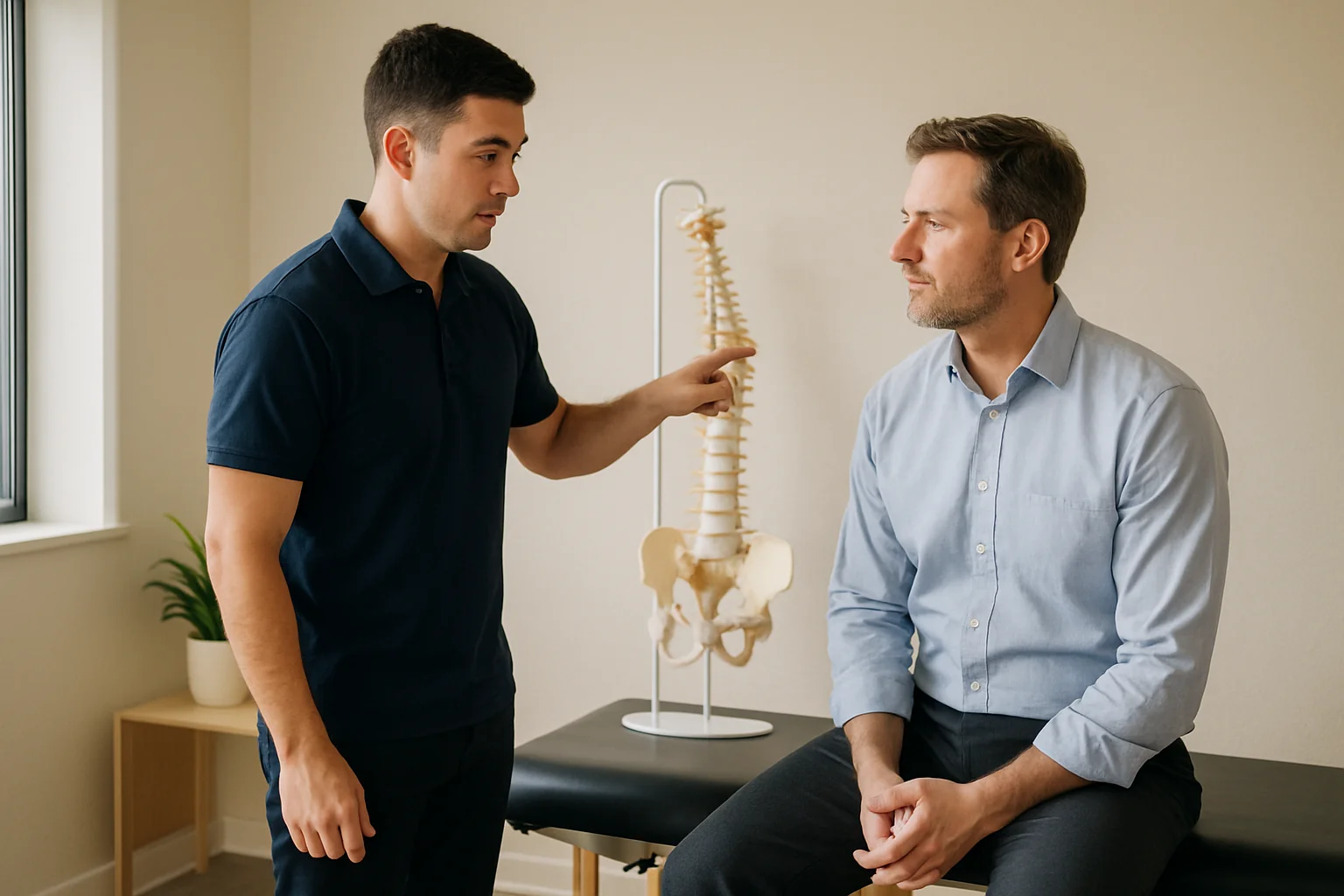
Why "You Strained Your Back" Is Not a Useful Explanation
Patients frequently leave primary care visits with a diagnosis of "lumbar strain" and a prescription for anti-inflammatories and rest. Sometimes that's appropriate for a genuinely acute soft-tissue injury. But for most people dealing with recurring or persistent lower back pain, "strain" functions more as a placeholder than an actual explanation. It describes a symptom, not a structure.
The problem with starting there is that if you don't know which structure is irritated — the disc, the facet joints, the sacroiliac joint, or the surrounding musculature — you can't predict how it will respond to treatment, how long recovery should take, or whether the approach you're using is appropriate for the actual diagnosis. Temporary relief becomes the default outcome, and the pain keeps coming back.
Most recurring lower back pain has a specific, identifiable structural driver. Finding it is not complicated — it requires a proper examination. What it doesn't require is guessing.
The Four Primary Structural Causes of Lower Back Pain
1. Lumbar Disc Dysfunction
The intervertebral discs sit between each lumbar vertebra, serving as shock absorbers and spacers that allow the spine to move. Each disc has a tough outer ring (annulus fibrosus) and a gel-like center (nucleus pulposus). When the annulus develops micro-tears from repetitive loading, prolonged flexion, or a specific injury, the nucleus can shift position — creating pressure on nearby nerve roots or on the disc's own internal nerve supply.
Disc-related lower back pain typically presents with pain that worsens with sitting and forward bending, improves with movement, and may refer into the buttock, hip, or leg. A true disc herniation — where the nucleus presses directly on a nerve root — produces more specific neurological symptoms: pain tracking into a predictable leg pattern, numbness or tingling in a defined area, or weakness in specific muscle groups. Understanding whether disc involvement is present, and at which level, determines whether traction-based approaches are appropriate, which directions of movement should be emphasized in care, and whether imaging is warranted.
2. Facet Joint Dysfunction
The facet joints are paired joints at the back of each spinal segment. They guide and limit spinal motion, bearing significant compressive load — particularly in extension and rotation. Like any joint, they can become irritated, inflamed, or restricted. Facet-driven lower back pain typically worsens with standing and walking (especially prolonged), improves with sitting, and tends to produce a more local, achy quality of pain rather than a sharp or radiating pattern.
Facet dysfunction is extremely common and often coexists with disc issues at the same spinal level. One of the reasons chiropractic adjustments are particularly effective for this presentation is that they directly address facet joint motion restriction — restoring normal joint mechanics rather than masking pain from the outside. Patients with primarily facet-driven pain often respond quickly to a structured adjustment protocol, though full stabilization requires addressing the load distribution patterns that caused the dysfunction in the first place.
3. Sacroiliac Joint Dysfunction
The sacroiliac (SI) joint connects the sacrum at the base of the spine to the ilium on each side of the pelvis. It's a large, relatively immobile joint stabilized by some of the strongest ligaments in the body — but "relatively immobile" doesn't mean it can't malfunction. SI joint dysfunction involves altered joint position or motion that creates pain in the low back, buttock, and sometimes the posterior thigh.
SI joint pain is frequently misdiagnosed as lumbar disc or facet pain because the symptom locations overlap. The distinguishing feature on examination is that SI joint provocation tests — specific loading maneuvers designed to stress the joint — reproduce the patient's pain, while lumbar nerve root tests do not. This distinction matters because SI joint dysfunction responds to a different set of interventions than disc or facet problems. Treating a lumbar disc when the SI joint is the actual driver produces partial results at best, and the pain returns predictably because the underlying dysfunction was never addressed.
4. Muscular Guarding — a Response, Not a Cause
This is worth clarifying directly: muscle spasm and tightness in the lower back is almost always a response to underlying joint or disc dysfunction, not a primary cause. The muscles surrounding a restricted or irritated spinal structure tighten protectively to limit motion at that segment. Treating the muscle tightness in isolation — through massage, stretching, or muscle relaxants — provides temporary relief because it addresses the symptom without changing the underlying structural problem driving it.
This is one reason why people find temporary relief with various treatments but the tightness keeps returning. The muscles are doing exactly what they're supposed to do — protecting a compromised structure. Until the underlying joint dysfunction or disc irritation is addressed, the guarding pattern will continue to regenerate.
Contributing Factors That Load the Same Structures
Beyond the primary structural cause, most lower back pain presentations involve secondary factors that increase load on the already-compromised structure. These aren't separate causes — they're contributors that either accelerated the original injury or are preventing recovery.
Prolonged sitting compresses lumbar discs at higher pressure than most other positions and progressively reduces disc hydration over the course of a workday. If you deal with lower back pain from sitting all day, that sustained compressive load is almost certainly a factor in why the disc or facet involvement hasn't resolved. Hip flexor tightness from the same prolonged hip flexion position increases anterior pelvic tilt, which shifts load to the posterior elements of the lumbar spine — the very facets and disc segments that are usually already compromised.
Poor movement patterns — particularly repeated forward bending under load without proper hip hinge mechanics — place disproportionate stress on the L4-L5 and L5-S1 segments. These are the levels where disc herniation, facet arthropathy, and spondylolisthesis occur most frequently, not by coincidence but because they carry the greatest mechanical load in the lumbar spine.
What "Wear and Tear" Actually Means — and What It Doesn't
Degenerative changes in the lumbar spine — disc space narrowing, facet arthritis, osteophyte formation — are extremely common findings on imaging and become more prevalent with age. This leads to two common misinterpretations: either that degenerative changes explain all lower back pain (they don't), or that they make the pain untreatable (they don't).
The research on lumbar imaging findings is clear: a significant percentage of people with no back pain have disc herniations, disc degeneration, and facet arthritis on MRI. Imaging findings describe what the spine looks like, not necessarily what's causing a specific patient's symptoms. The clinical evaluation — understanding what positions and activities reproduce or relieve the pain, what provocation tests are positive, and what the movement assessment reveals — provides more diagnostic information than imaging alone in most cases.
Degenerative changes don't disqualify someone from getting better. What matters is whether the pain is being generated by a structure that can be directly influenced by treatment — and in most lower back pain cases, it is.
Why Knowing the Cause Changes Everything About Treatment
When the structural driver is clearly identified, the treatment approach changes significantly. A lumbar disc in the acute irritation phase requires a different set of techniques and positions than a restricted facet joint. An SI joint dysfunction responds best to specific pelvic manipulation and stabilization work. Applying the same generic adjustment protocol to all three presentations produces inconsistent results because the technique isn't matched to the pathology.
Beyond technique selection, a clear diagnosis allows for realistic timeline expectations. Facet joint dysfunction that has been present for a few weeks often responds quickly — meaningful improvement in two to three weeks of structured care is realistic. Disc involvement with nerve root irritation takes longer; the neural tissue recovers more slowly than the joint, and the disc itself needs sustained unloading over time. Patients who understand this trajectory stay in care through the full resolution rather than stopping when pain improves but the structural correction isn't complete.
For a practical overview of what to expect during structured lower back treatment, including how progress is tracked and what a complete course of care looks like, see our overview of back pain relief in Overland Park.
When Lower Back Pain Requires a Different Kind of Attention
Most lower back pain is mechanical — meaning it's driven by structural dysfunction in the joints, discs, or surrounding soft tissue, and it responds to mechanical treatment. But some lower back pain presentations indicate something beyond a musculoskeletal problem and require medical evaluation rather than chiropractic care as a first step.
Red flags that warrant prompt medical evaluation include lower back pain that is constant and not affected by position or movement, significant unintentional weight loss alongside new back pain, back pain in someone with a known history of cancer, fever with back pain, or progressive neurological findings — increasing weakness, numbness expanding to new areas, or any loss of bowel or bladder control. These presentations need imaging and medical assessment before starting manual treatment.
For the large majority of patients presenting without these red flags, the cause is structural and the path forward involves a proper mechanical evaluation, a clear diagnosis, and a structured treatment plan tied to that diagnosis.
The Evaluation Is Where It Starts
The reason so many people cycle through treatments without lasting results isn't that their back pain is uniquely difficult. It's that they've been treated for symptoms rather than causes. Ice, heat, massage, and generic exercises all have value — but none of them change the structural dysfunction driving the pain, and none of them are substitutes for understanding what that dysfunction actually is.
A proper structural evaluation of lower back pain takes time and requires someone who is examining the spine with the intent to diagnose, not just to treat. It includes an orthopedic examination of the lumbar and sacral segments, provocation testing to identify which structures are symptomatic, a movement assessment, neurological screening, and a clear explanation of what the findings mean and what treatment approach follows from them.
The goal isn't temporary relief from today's pain. It's identifying what's actually wrong — and building a plan that addresses it directly.
Serving Overland Park and Johnson County
If you're in Overland Park, Leawood, Lenexa, Olathe, or elsewhere in Johnson County dealing with lower back pain that keeps returning despite various treatments, the problem is almost certainly that the structural cause hasn't been clearly identified and directly addressed. Most people with persistent lower back pain are not untreatable — they haven't had a real evaluation that explained what's actually wrong.
If you're dealing with this and want a clear plan, the next step is a proper evaluation. At Quality Life Chiropractic in Overland Park, we focus on identifying the root issue and building a structured plan to fix it.
Frequently Asked Questions
What is the most common cause of lower back pain?
Lumbar disc irritation and facet joint dysfunction are the two most common structural causes, and they frequently coexist at the same spinal level. Sacroiliac joint dysfunction is the third most common presentation and is often mistaken for disc or facet pain because the symptom locations overlap. Identifying which structure is primarily responsible requires a proper physical examination — imaging alone rarely provides this answer.
Can lower back pain go away on its own?
Many acute lower back pain episodes do resolve within a few weeks, particularly when the episode was triggered by a specific incident and the underlying structural dysfunction is mild. However, "going away" is not the same as being resolved — many people experience pain reduction followed by recurrence because the joint restriction, disc irritation, or movement pattern driving the pain was never fully addressed. Recurring back pain is a sign that the structural cause has not been corrected.
Is my lower back pain from bad posture?
Posture is a contributing factor, not typically the primary cause. Sustained poor posture — particularly prolonged forward flexion or anterior pelvic tilt — increases compressive load on specific spinal structures over time and can accelerate disc degeneration or facet irritation at vulnerable segments. But describing the pain as "from bad posture" isn't a useful clinical explanation. The more important question is which structure is being overloaded by that posture, and whether that structure is now generating pain directly.
How do I know if my lower back pain is a disc or something else?
Disc-driven pain typically worsens with sitting and forward bending, and may radiate into the buttock or leg following a predictable nerve pathway. Facet pain typically worsens with standing and extension and stays more local to the spine. Sacroiliac pain is usually one-sided, concentrated in the low back and buttock, and reproduced by specific loading tests. These are useful patterns, but they overlap — the most reliable way to distinguish between them is a physical examination that tests each structure directly.
When should lower back pain be taken seriously?
Lower back pain accompanied by progressive neurological symptoms (increasing weakness, expanding numbness, or loss of bowel or bladder control), constant pain unaffected by position, fever, unexplained weight loss, or a personal history of cancer should be medically evaluated promptly. For mechanical lower back pain without these findings, seeking care sooner rather than later produces better outcomes — pain that has been present for months is harder to resolve than pain that has been present for weeks.