What Graston Technique Actually Is
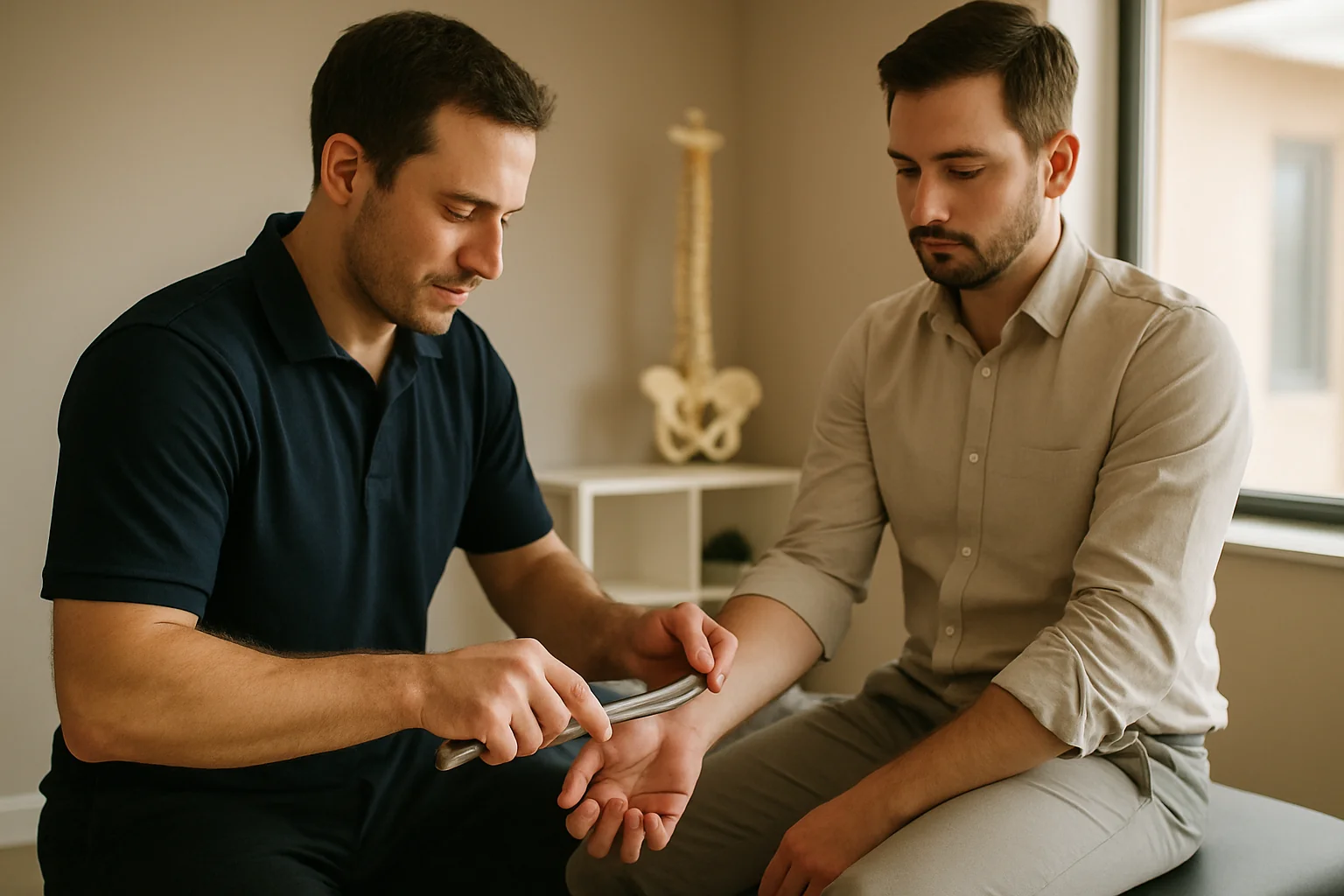
Graston Technique is a form of instrument-assisted soft tissue mobilization, or IASTM. Instead of using hands alone, the clinician uses a set of contoured stainless steel instruments to scan and treat soft tissue. The instruments are shaped to match different body regions — long and flat for the IT band or paraspinals, curved and narrow for the Achilles tendon or forearm.
The reason instruments matter isn't marketing. Steel transmits vibration in a way that hands can't. When the edge of the instrument passes over healthy, organized tissue, it glides smoothly. When it passes over an adhesion or area of fibrotic buildup, the clinician feels a distinct gritty resonance through the instrument — and often the patient feels it too. That tactile feedback localizes restriction with a precision that's difficult to achieve with hands alone.
Once a restriction is found, the same instrument provides the treatment: controlled, directional strokes that create a targeted microtrauma in the adhered tissue. That word — microtrauma — sounds counterproductive, but it's the mechanism that drives the result.
Why Controlled Microtrauma Heals Tissue
Scar tissue and fascial adhesions form when the body lays down collagen quickly and disorganizedly — after an injury, after surgery, or gradually under repetitive strain. Healthy fascia is organized in aligned layers that slide over each other. Scarred tissue is laid down like a tangled net. It's strong, but it doesn't glide, it doesn't lengthen well, and it often binds layers of tissue together that are supposed to move independently.
The body doesn't remodel that disorganized tissue on its own once the original injury has healed, because there's no longer an active repair signal in the area. Graston reintroduces one. The controlled mechanical input stimulates local inflammation — briefly and deliberately — which recruits fibroblasts, the cells responsible for producing and reorganizing collagen. Over a series of treatments, paired with appropriate loading and movement, the tissue remodels along the lines of stress into a more organized, functional structure.
This is why Graston is not a one-session fix. The remodeling process follows biological timelines, not appointment schedules. Most tissue responds meaningfully within four to ten sessions, depending on how long the restriction has been there and how well the treatment is paired with movement and load.
The Conditions Where Graston Earns Its Reputation
Graston is most useful where fibrotic tissue is the primary driver of the problem. In my practice, the presentations that respond most consistently are:
- Tendinopathies — tennis elbow, golfer's elbow, Achilles and patellar tendon problems
- Chronic muscle strains that healed tight, particularly hamstrings and calves
- Post-surgical scarring that limits motion, once the surgeon has cleared soft tissue work
- Plantar fasciitis, especially when it's persisted past the acute phase
- IT band restriction in runners and cyclists
- Forearm and wrist overuse problems from desk work or repetitive gripping
Tennis elbow is a good example of where the technique fits a structured plan. The problem is rarely inflammation by the time most people seek care — it's degenerated, disorganized tendon tissue that needs a remodeling stimulus. This post on chiropractic care for tennis elbow walks through why treating the tendon alone often isn't enough, and the same logic applies to most of the conditions on this list.
What Graston Doesn't Do
This matters as much as what it does. Graston does not fix joint restriction — if a spinal segment or extremity joint isn't moving properly, no amount of soft tissue work will correct that. It doesn't address the movement pattern or workload that created the adhesion in the first place. And it's not appropriate for acute injuries that are still in the inflammatory phase, over areas of active infection, or for patients with certain clotting disorders or on anticoagulant therapy.
The honest boundary: if your problem is primarily joint dysfunction, nerve compression, or an unaddressed training error, Graston alone will give you temporary relief at best. The soft tissue tension will return because the thing generating it is still there. This is why an evaluation comes first — the question isn't "would Graston feel productive here," it's "is fibrotic soft tissue actually the driver of this problem, or a symptom of something else?"
In practice, Graston works best in sequence with joint work. Restore the joint mechanics first, then remodel the soft tissue that adapted around the dysfunction. The same sequencing principle applies to cupping, which approaches soft tissue from the opposite direction — decompression rather than compression. This post on how long cupping takes to work explains how we decide between the two, and when they're used together.
What a Graston Session Feels Like
Patients are often braced for pain, and it's worth setting realistic expectations. Over healthy tissue, the instrument strokes feel like a firm massage. Over restricted tissue, there's a distinct gritty, sandpaper-like sensation — uncomfortable but tolerable, and most patients describe it as a "productive" discomfort rather than sharp pain. Treatment of any one area typically lasts only 30 to 90 seconds. More is not better; the goal is to stimulate remodeling, not to bulldoze the tissue.
Mild redness afterward is normal and expected — it reflects the increased local circulation that drives the healing response. Some patients develop light petechiae, small red dots in the treated area, which resolve within a few days. Soreness comparable to a workout is common for 24 to 48 hours after the first session or two, and typically diminishes as the tissue improves.
What you should track isn't how the session felt — it's whether the change holds. Each session should produce improvement that lasts longer than the last. If range of motion and pain are improving week over week, the tissue is remodeling. If results plateau, something in the plan needs to change.
How Graston Fits a Structured Plan at QLC
Graston is one tool in the treatment plan, not the plan itself. A typical visit that includes Graston also includes joint assessment and adjustment where indicated, and specific loading exercises for the treated tissue — because remodeling collagen needs directional stress to organize properly. Treatment frequency is usually once or twice per week initially, spaced out as the tissue holds its gains.
For chronic problems, the timeline conversation matters. Tissue that has been adhered for years didn't get that way in a month, and it won't fully remodel in a month either. Most patients see meaningful change within four to six sessions; full resolution of long-standing restriction often takes eight to twelve. This post on chiropractic care for chronic pain covers why chronicity changes the treatment approach — the same principles govern how we plan soft tissue work.
The goal is always resolution, not management. When the plan is working, sessions get further apart, the tissue holds, and you're discharged with the loading program that keeps it that way.
Serving Overland Park and Johnson County
We see patients from Overland Park, Leawood, Lenexa, Olathe, Prairie Village, and Shawnee. Graston Technique is one of several soft tissue tools we use at QLC — alongside cupping, joint mobilization, and spinal adjustment — depending on what the evaluation identifies as the right approach for your specific problem.
If you're dealing with this and want a clear plan, the next step is a proper evaluation. At Quality Life Chiropractic in Overland Park, we focus on identifying the root issue and building a structured plan to fix it.
Frequently Asked Questions
Does Graston Technique hurt?
Over restricted tissue it's uncomfortable — most patients describe a gritty, sandpaper-like sensation rather than sharp pain. Treatment of any single area lasts under two minutes, and the intensity is adjusted to your tolerance. Mild soreness for a day or two afterward is normal, similar to a hard workout.
How many Graston sessions will I need?
It depends on how long the restriction has existed. Recent overuse problems often improve meaningfully in three to five sessions. Chronic adhesions or post-surgical scarring more realistically take eight to twelve, paired with loading exercises. The indicator of progress is whether improvement holds longer after each session.
Is Graston the same as scraping or gua sha?
They share the same general principle — instrument-assisted soft tissue work — but Graston is a standardized, trademarked protocol with specific instruments, stroke patterns, and clinician training. The bigger difference is context: at QLC, Graston is applied after an evaluation determines that fibrotic soft tissue is actually driving your problem, and it's paired with joint work and rehabilitation rather than used as a standalone therapy.
Can Graston be combined with an adjustment in the same visit?
Yes, and that's typically how we use it. Joint restriction and soft tissue restriction usually coexist — treating the joint first, then the soft tissue around it, produces longer-lasting results than either alone.
Does Quality Life Chiropractic see patients from outside Overland Park?
Yes. We regularly see patients from Leawood, Lenexa, Olathe, Prairie Village, Shawnee, and throughout Johnson County, KS.