
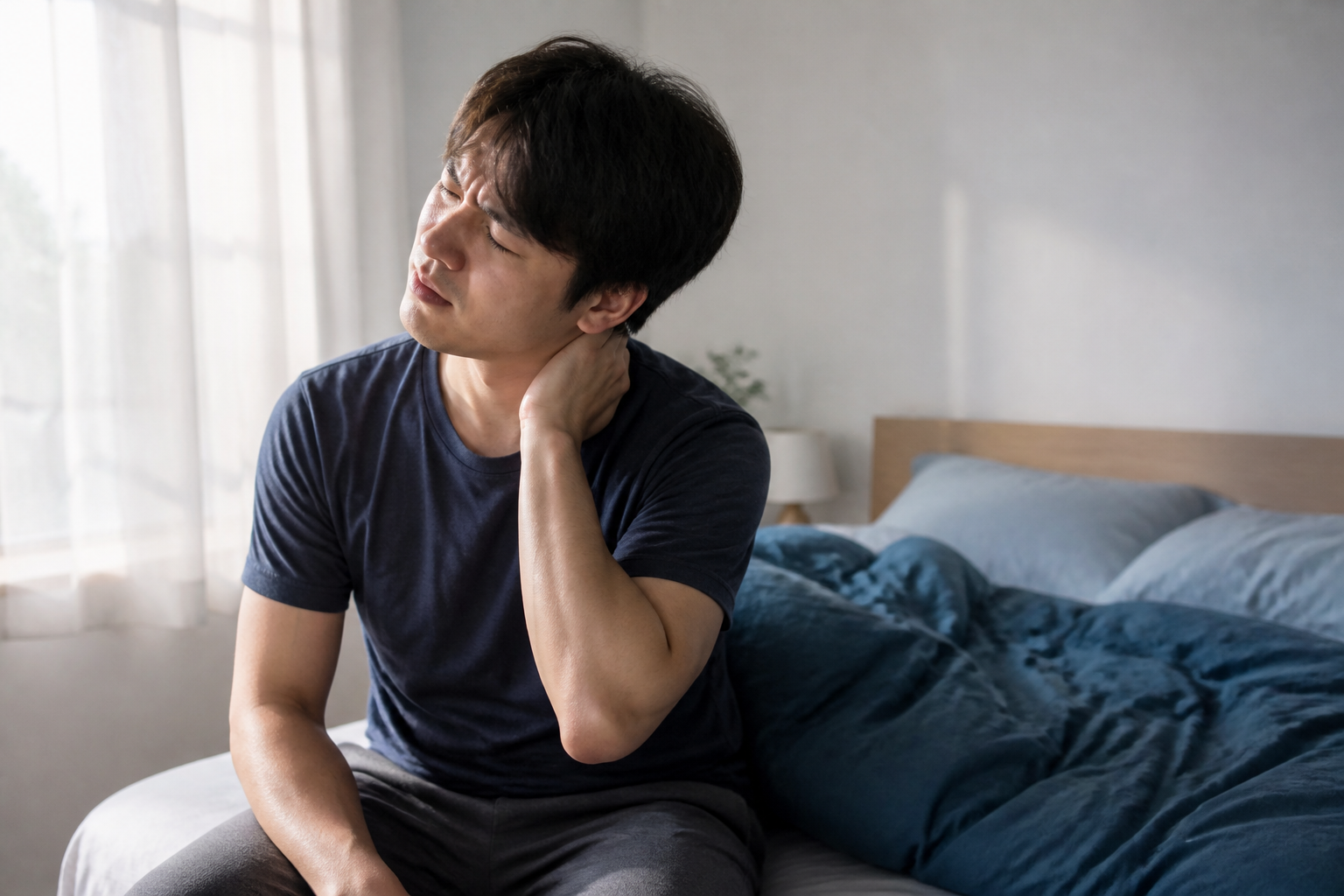
Why It Feels Sudden When It Isn't
The most disorienting aspect of waking up with severe neck restriction is that you felt normal when you went to sleep. This creates the impression that something catastrophic happened overnight. In most cases, that's not accurate. What happened overnight was a final trigger on top of an existing vulnerability.
Cervical facet joints — the small paired joints behind each cervical vertebra that guide and limit neck rotation — can accumulate restriction over time without producing noticeable pain. You may have been driving, sitting at a desk, or looking at screens in ways that progressively reduced the range of motion at certain segments. You weren't symptomatic because the restriction hadn't crossed the threshold into pain. Then you slept in a position that held those already-restricted joints at end range for several hours, the joint capsule became irritated and swollen, and you woke up in acute restriction.
The sleep position didn't cause the problem from scratch — it revealed a structural vulnerability that was already there. This distinction matters because it explains why the same sleeping position that gives one person a stiff neck in the morning has no effect on another. The person who gets the acute restriction had underlying joint dysfunction. The one who doesn't was starting from a mechanically healthier baseline.
The Cervical Facet Joint: Why Morning Restriction Happens Here
Each cervical vertebra (C2 through C7) has two pairs of facet joints — one on each side — that are oriented at angles specific to each level. At the upper cervical levels (C1-C2), the joints are designed primarily for rotation: roughly 50% of total neck rotation happens at the atlantoaxial joint alone. At the mid and lower cervical levels (C3-C7), the facet joints contribute to both rotation and side bending simultaneously, because of the way the joint planes are angled.
When a facet joint at any of these levels loses its normal mobility — through accumulated postural loading, a previous mild injury that was never fully resolved, or degenerative changes — it becomes what we call a restricted or fixated segment. The joint can move, but not through its full normal range. The muscles around it tighten to protect it. This is a stable, adapted state that often produces no symptoms in daily activity.
The problem occurs during sleep because several things happen simultaneously: sustained compression in a single position, reduced blood flow through the synovial joint capsule, and decreased protective muscle activity (since you're relaxed and not consciously stabilizing). If the restricted joint is held at or near its end range for several hours in this state, the capsule becomes acutely irritated and swollen. When you wake up, the combination of capsular inflammation and protective muscle guarding creates the severe restriction you experience.
The acute morning presentation is almost always a cervical facet event — not a disc herniation, not a muscle strain. Identifying which level or levels are involved is what allows treatment to be targeted and effective.
Which Structures Are Actually Involved
Cervical Facet Joints (Most Common)
As described above, facet joint restriction at one or more cervical levels is the primary driver of the vast majority of "woke up can't turn head" presentations. The restriction is specific — palpation of the affected segments will produce a distinct reproduction of the patient's pain, and motion testing will confirm which directions are limited and at which level. This is not a diffuse, generalized stiffness; it's a focal mechanical restriction at identifiable vertebral segments.
The pattern is most commonly unilateral — restricted on one side — which is why you can usually tilt your head toward the painful side but not rotate toward it, or can rotate one direction but not the other. The asymmetry is a clinical fingerprint pointing directly to which level and which side is involved.
Atlantoaxial Restriction (Upper Cervical)
When the restriction involves the top two cervical vertebrae (C1 on C2), the presentation is often more global: the patient reports they can barely turn at all, and there's a feeling of the neck being "stuck" in a central position rather than just restricted in one direction. The atlantoaxial joint is responsible for the majority of neck rotation, and when it's acutely restricted, the movement loss is correspondingly dramatic. This level is also more commonly involved in people with prior whiplash history, since the atlantoaxial complex is particularly vulnerable to torsional loading.
Muscular Guarding (Secondary, Not Primary)
The severe muscle spasm that accompanies acute morning neck restriction — the tight, painful levator scapulae and upper trapezius on the affected side, the splenic capitis that feels like a cord of wire — is a secondary response to the joint event, not the primary cause. This is important to understand because it explains why muscle treatments alone (massage, heat, anti-inflammatory medication) provide incomplete relief. The muscles are protecting the acutely irritated joint. They will continue guarding until the joint restriction is addressed.
This is the same principle that applies to most neck and back pain: the muscle tightness is a symptom of the underlying joint problem, not the problem itself. Releasing the muscle without correcting the joint gives temporary relief because the muscles will re-tighten as long as the joint is still dysfunctional.
Disc Involvement (Less Common)
In a smaller subset of patients — particularly those over 45 with known degenerative disc disease, or those who wake up with arm symptoms (numbness, tingling, radiating pain) in addition to neck restriction — a cervical disc may be involved. The disc at the affected level can be compressed in a position-dependent way overnight, producing acute inflammation around an already narrowed disc space. This presentation tends to resolve more slowly and may require imaging to guide treatment safely. Arm symptoms accompanying the morning neck restriction are a signal to get a proper evaluation before attempting self-treatment.
Why Your Sleeping Position Is Often the Trigger, Not the Cause
Most people with acute morning neck restriction spend significant mental energy reconstructing what they did differently the night before. A new pillow, sleeping on the couch, an unusual position. And often, they can identify something. But here's the clinical reality: the position was the trigger, not the cause.
A healthy cervical spine with full facet joint mobility and no underlying restriction can tolerate a wide range of sleeping positions without producing acute restriction. It may be slightly stiff in the morning from an unusual position, but it won't be locked. The reason one position produced a dramatic restriction in your case is that your cervical spine wasn't starting from a fully mobile baseline. The restricted joint that was quietly adapted was pushed over threshold by hours of sustained end-range loading.
This is why addressing the pillow height or sleeping position — while potentially helpful for reducing future triggering events — doesn't fix the underlying issue. The facet restriction that was present before the acute episode will still be there after it resolves. Without correcting the underlying joint dysfunction, the next triggering event will produce the same result.
If you've had this happen before — multiple episodes of waking up with acute neck restriction over months or years — that pattern is the clearest evidence that there's an underlying structural issue that was never addressed after the first episode resolved. Our post on waking up with neck pain in Overland Park covers the general morning neck pain picture; this post focuses specifically on the presentation where rotation is severely limited.
What a Proper Evaluation Finds
A thorough evaluation of acute morning cervical restriction involves segmental motion testing of each cervical level to identify which joints are restricted and in which directions, palpation to confirm pain provocation at the affected segments and rule out other structures, a neurological screening examination to assess for disc or nerve root involvement (particularly important when arm symptoms are present), and an assessment of upper thoracic mobility, which often contributes to cervical restriction when the upper thoracic facets are also limited.
The goal of the evaluation is not just to establish that you have neck pain — that's obvious. The goal is to identify the specific levels and directions of restriction, rule out presentations that require different management (cord compression, fracture, vascular involvement), and build a treatment plan targeted to the actual mechanical problem found on examination.
For context on what this type of structured chiropractic approach looks like in practice, the overview of chiropractic for neck pain covers how a structured evaluation differs from a generic adjustment approach.
How Acute Morning Neck Restriction Is Treated
The primary treatment for cervical facet restriction is cervical manipulation or mobilization — specific, directed force to the restricted joint to restore normal mobility. When the correct level and direction of restriction have been identified through examination, this produces immediate improvement in range of motion in most cases. The capsular inflammation that developed overnight reduces as the joint mechanics normalize, and the protective muscle guarding begins to resolve as the joint is no longer in a provocative position.
It is worth noting that high-velocity manipulation of an acutely inflamed cervical joint requires clinical judgment. In some presentations, particularly when the joint is in acute spasm and the patient has significant pain with any movement, a staged approach starting with gentler mobilization techniques is more appropriate than immediate high-velocity adjustment. A competent cervical evaluation includes an assessment of the appropriate technique for the presentation, not just what the diagnosis is.
The upper thoracic spine is almost always treated alongside the cervical spine in these cases. Upper thoracic restriction is a common co-contributor to cervical joint loading, and treating only the cervical levels while leaving thoracic restriction in place produces less complete and less durable results.
Most patients with a straightforward cervical facet presentation — no disc involvement, no arm symptoms, clear segmental restriction on examination — experience significant improvement in rotation range within the first one to two treatment sessions. Full resolution, and correction of the underlying restriction pattern that made them susceptible in the first place, typically takes additional visits over two to four weeks.
When to Seek Evaluation Immediately
Most acute morning neck restriction is mechanical and can be safely evaluated by a chiropractor. But certain presentations warrant prompt medical evaluation before beginning manual treatment.
Seek immediate care — emergency or urgent medical — if your neck restriction is accompanied by any of the following: significant trauma preceding the episode (a fall, collision, or forceful movement, even if it seemed minor); arm weakness, not just pain or numbness but true weakness in grip or shoulder elevation; bilateral arm symptoms; loss of coordination or balance problems; headache that is sudden, severe, and unlike any you've had before; fever or signs of infection. These presentations raise the possibility of cord compression, fracture, or vascular involvement that requires imaging before manual treatment.
For acute morning neck restriction without these red flags — particularly the classic presentation of waking up unable to turn your head in one direction, with unilateral pain and muscle guarding, following a day of desk work or travel — a chiropractic evaluation is the appropriate first step. Waiting several days to see if it "works itself out" is a reasonable approach for a mild episode, but moderate to severe restriction that significantly limits function is worth evaluating promptly rather than hoping it resolves spontaneously.
Serving Overland Park and Johnson County
If you're in Overland Park, Leawood, Lenexa, Olathe, or elsewhere in Johnson County and you've woken up unable to turn your head — whether for the first time or as a recurring pattern — the structural cause can be identified and corrected. Recurring episodes are particularly worth addressing, since each one is evidence that the underlying joint restriction was never fully resolved after the previous episode.
If you're dealing with this and want a clear plan, the next step is a proper evaluation. At Quality Life Chiropractic in Overland Park, we focus on identifying the root issue and building a structured plan to fix it.
Frequently Asked Questions
Why did I wake up and can't turn my head to one side?
The most likely cause is acute cervical facet joint restriction — one or more of the small joints behind your cervical vertebrae became acutely irritated overnight. This typically happens when an already-restricted joint is held at end range during sleep, causing the joint capsule to swell and the surrounding muscles to go into protective spasm. The asymmetry — restricted in one direction but not the other — is a clinical indicator pointing to which level and which side is involved, which is what a physical examination confirms.
Will it go away on its own?
Mild cases often improve over two to three days as the acute capsular inflammation subsides. Moderate to severe restriction that significantly limits function may take longer and frequently benefits from early chiropractic care — treating the restriction directly, rather than waiting for the inflammatory response to settle on its own, typically produces faster and more complete recovery. More importantly, the underlying joint restriction that made you susceptible will remain after the acute episode resolves. Without addressing it, the same thing can happen again.
Should I go to the chiropractor or urgent care?
For acute morning neck restriction without arm symptoms, trauma, fever, or neurological signs, a chiropractor is the appropriate first stop. A chiropractic evaluation includes the neurological screening needed to rule out serious pathology, and cervical manipulation is the most direct treatment for facet-driven restriction. Urgent care is more appropriate if you have arm weakness, symptoms following trauma, severe headache, or fever — those presentations require imaging before manual treatment.
Why does this keep happening to me?
Recurrent episodes of waking up with acute neck restriction almost always indicate an underlying cervical joint dysfunction that was never fully corrected after the first episode. The pattern — acute episode, recovery over a few days, returning to "normal," then another episode months later — is consistent with a restricted cervical segment that never regained full mobility and remains susceptible to re-aggravation with any sustained end-range positioning. A structured evaluation and course of care aimed at restoring normal cervical joint mechanics, rather than just treating the acute episode, breaks the cycle.
Is heat or ice better when I can't turn my head?
Ice is generally more appropriate in the acute phase — the first 24 to 48 hours — when the primary issue is joint capsule inflammation. Ice reduces inflammation more effectively than heat in this window. Heat may provide more comfort for muscle guarding and can be used in the subacute phase once the acute inflammation has settled. Neither significantly addresses the underlying joint restriction; they're comfort measures while the primary problem is being treated.
How long does it take to recover from waking up with neck pain you can't turn?
With chiropractic treatment targeting the specific cervical levels involved, most patients notice meaningful improvement in rotation range within one to two sessions. Full resolution of the acute episode typically occurs within one to two weeks. Addressing the underlying restriction pattern that predisposes to these episodes takes additional care over a longer treatment course, but this is what prevents recurrence rather than just treating each acute event as it happens.